Ch. 20 - The Organic Chemistry of Carbohydrates
Bruice - Organic Chemistry 8th Edition
Bruice8th EditionOrganic ChemistryISBN: 9780135213711당신이 사용하는 게 아니라요?교과서 변경
20장, 문제 34c

What product or products are obtained when D-galactose reacts with each of the following?
c. NaBH4, followed by H3O+

검증된 단계별 안내
1
Identify the functional groups present in d-galactose. D-galactose is an aldose sugar, meaning it contains an aldehyde group (-CHO) at the anomeric carbon and multiple hydroxyl (-OH) groups.
Understand the role of NaBH4 (sodium borohydride). NaBH4 is a reducing agent that specifically reduces aldehydes and ketones to their corresponding alcohols. In this case, the aldehyde group in d-galactose will be reduced to a primary alcohol (-CH2OH).
Write the reaction mechanism for the reduction. NaBH4 donates a hydride ion (H⁻) to the carbonyl carbon of the aldehyde group, converting it into an alkoxide intermediate. This intermediate is then protonated by H3O+ (acidic workup) to form the primary alcohol.
Determine the structure of the product. After the reduction, the aldehyde group at the anomeric carbon of d-galactose is replaced by a primary alcohol group (-CH2OH), while the rest of the molecule (the hydroxyl groups on the other carbons) remains unchanged.
Conclude the reaction outcome. The product of this reaction is d-galactitol (also known as dulcitol), a sugar alcohol derived from d-galactose. No other products are formed in this reaction.

비슷한 문제에 대한 검증된 영상 답변:

이 영상 해법은 위 문제에 도움이 된다고 튜터들이 추천한 것입니다.
영상 길이:
2m

주요 개념

질문에 올바르게 답하기 위해 반드시 이해해야 하는 핵심 개념들은 다음과 같습니다.

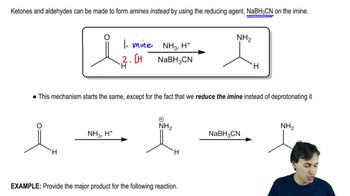
Reduction Reactions

Reduction reactions involve the gain of electrons or hydrogen, or the loss of oxygen. In organic chemistry, this often refers to the conversion of carbonyl groups (like aldehydes and ketones) into alcohols. In the case of d-galactose, the reaction with NaBH4, a strong reducing agent, will reduce the aldehyde group to a primary alcohol.
추천 영상:
07:12
Reductive Amination

Hydrolysis

Hydrolysis is a chemical reaction that involves the breaking of a bond in a molecule using water. In the context of the reaction with H3O+, hydrolysis can help in converting any intermediate formed during the reduction into a stable product. This step is crucial for ensuring that the final product is in its desired alcohol form after reduction.
추천 영상:
가이드 코스
1:00
Hydrolysis of Thioesters Concept 2

Stereochemistry of Sugars

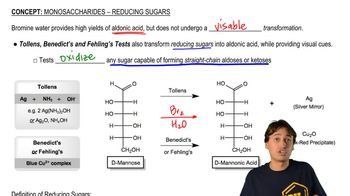
Stereochemistry refers to the spatial arrangement of atoms in molecules and how this affects their chemical behavior. d-Galactose is a stereoisomer of glucose, and its specific configuration influences the outcome of reactions. Understanding the stereochemistry of d-galactose is essential for predicting the structure of the final product after reduction and hydrolysis.
추천 영상:
08:42
Reducing Sugars