Ch. 22 - Catalysis in Organic Reactions and in Enzymatic Reactions
Bruice - Organic Chemistry 8th Edition
Bruice8th EditionOrganic ChemistryISBN: 9780135213711당신이 사용하는 게 아니라요?교과서 변경
22장, 문제 4a

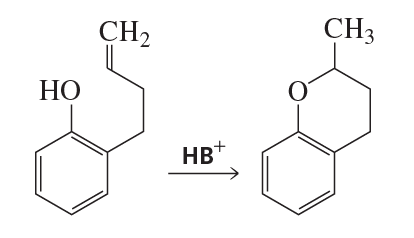
Draw the mechanism for the following reaction if it involves specific-acid catalysis.
Chemical reaction mechanism illustrating acid-catalyzed alkoxylation, showing reactants and products with structural formulas.

검증된 단계별 안내
1
Identify the functional groups in the reactant and determine the type of reaction taking place (e.g., substitution, addition, elimination, etc.). Specific-acid catalysis typically involves protonation of a functional group to make it more reactive.
Protonate the most likely site on the reactant using a proton (H⁺) from the acid catalyst. This step increases the electrophilicity of the molecule, making it more susceptible to nucleophilic attack or other transformations.
Determine the next step in the mechanism based on the protonated intermediate. For example, if a carbocation is formed, consider whether a nucleophile will attack or if a rearrangement might occur.
Draw the intermediate structures for each step of the reaction, ensuring that all charges and lone pairs are accounted for. Use curved arrows to show the movement of electrons during bond formation and bond breaking.
Conclude the mechanism by showing the final product and regenerating the acid catalyst (if applicable). Verify that the overall reaction is consistent with the principles of specific-acid catalysis.

비슷한 문제에 대한 검증된 영상 답변:

이 영상 해법은 위 문제에 도움이 된다고 튜터들이 추천한 것입니다.
영상 길이:
5m

주요 개념

질문에 올바르게 답하기 위해 반드시 이해해야 하는 핵심 개념들은 다음과 같습니다.

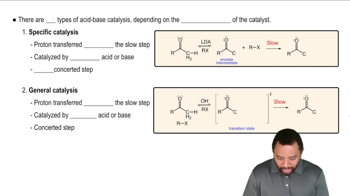
Specific Acid Catalysis

Specific acid catalysis refers to the acceleration of a chemical reaction by the addition of an acid that donates protons (H+) to the reactants. In this process, the acid interacts with the substrate, enhancing its electrophilicity and facilitating the formation of a transition state. This mechanism is crucial in organic reactions, particularly in hydration and esterification, where protonation of functional groups can significantly lower the activation energy.
추천 영상:
가이드 코스
2:50
Acid-Base Catalysis Concept 3

Reaction Mechanism

A reaction mechanism is a detailed step-by-step description of the pathway through which reactants are converted into products. It outlines the sequence of elementary steps, including bond breaking and formation, and the role of catalysts. Understanding the mechanism is essential for predicting the outcome of reactions and for designing new synthetic pathways in organic chemistry.
추천 영상:
02:16
Heck Reaction Mechanism

Proton Transfer

Proton transfer is a fundamental process in acid-base chemistry where a proton (H+) is transferred from an acid to a base. In the context of specific acid catalysis, this transfer is often the first step, leading to the activation of the substrate. This concept is vital for understanding how acids can enhance reaction rates and alter the stability of intermediates in organic reactions.
추천 영상:
03:
Proton Splitting