
Ch. 22 - Catalysis in Organic Reactions and in Enzymatic Reactions
Bruice - Organic Chemistry 8th Edition
Bruice8th EditionOrganic ChemistryISBN: 9780135213711당신이 사용하는 게 아니라요?교과서 변경
22장, 문제 34

The rate constant for the uncatalyzed reaction of two molecules of glycine ethyl ester to form glycylglycine ethyl ester is 0.6 M-1 s-1. In the presence of Co2+, the rate constant is 1.5 × 10⁶ M-1 s-1. What rate enhancement does the catalyst provide?

검증된 단계별 안내
1
Understand the problem: The question asks for the rate enhancement provided by the catalyst. This is calculated by comparing the rate constant of the catalyzed reaction to the rate constant of the uncatalyzed reaction.
Identify the given values: The rate constant for the uncatalyzed reaction is k₁ = 0.6 M⁻¹s⁻¹, and the rate constant for the catalyzed reaction is k₂ = 1.5 × 10⁶ M⁻¹s⁻¹.
Set up the formula for rate enhancement: Rate enhancement is defined as the ratio of the catalyzed rate constant to the uncatalyzed rate constant. Mathematically, this is expressed as: k₂k₁.
Substitute the given values into the formula: Replace k₁ and k₂ with their respective values in the formula: 1.5×1060.6.
Simplify the expression to find the rate enhancement: Perform the division to calculate the ratio, which will give the magnitude of the rate enhancement provided by the catalyst.

비슷한 문제에 대한 검증된 영상 답변:

이 영상 해법은 위 문제에 도움이 된다고 튜터들이 추천한 것입니다.
영상 길이:
2m

주요 개념

질문에 올바르게 답하기 위해 반드시 이해해야 하는 핵심 개념들은 다음과 같습니다.

Rate Constant

The rate constant (k) is a proportionality factor in the rate equation of a chemical reaction, indicating the speed at which reactants are converted to products. It is specific to a given reaction at a particular temperature and is influenced by factors such as concentration and the presence of catalysts. In this question, the rate constants for both the uncatalyzed and catalyzed reactions are provided, which are essential for calculating the rate enhancement.
추천 영상:
가이드 코스
2:29
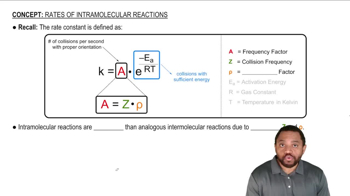
Rates of Intramolecular Reactions Concept 1

Catalysis

Catalysis is the process by which the rate of a chemical reaction is increased by the presence of a catalyst, which is a substance that is not consumed in the reaction. Catalysts work by providing an alternative reaction pathway with a lower activation energy, allowing the reaction to proceed more quickly. In this scenario, Co2+ acts as a catalyst, significantly increasing the rate constant from 0.6 M - 1s - 1 to 1.5 * 10^6 M - 1s - 1.
추천 영상:
가이드 코스
2:31
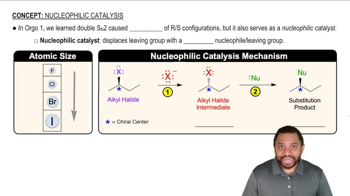
Nucleophilic Catalysis Concept 1

Rate Enhancement

Rate enhancement refers to the factor by which a catalyst increases the rate of a reaction compared to the uncatalyzed reaction. It is calculated by dividing the rate constant of the catalyzed reaction by that of the uncatalyzed reaction. In this case, the rate enhancement can be determined by taking the ratio of the two given rate constants, illustrating the effectiveness of the catalyst in accelerating the reaction.
추천 영상:
가이드 코스
5:07
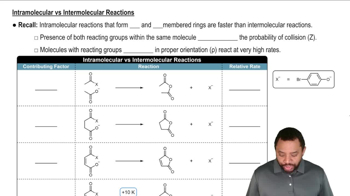
Rates of Intramolecular Reactions Concept 2