Ch. 3 - An Introduction to Organic Compounds: Nomenclature, Physical Properties, and Structure
Bruice - Organic Chemistry 8th Edition
Bruice8th EditionOrganic ChemistryISBN: 9780135213711당신이 사용하는 게 아니라요?교과서 변경
3장, 문제 57(1,2)

a. What is each compound’s systematic name?
b. Draw a skeletal structure for each condensed structure given and draw a condensed structure for each skeletal structure.
1. (CH3)3CCH2CH2CH2CH(CH3)2
2.

검증된 단계별 안내
1
Step 1: Analyze the condensed structure (CH3)3CCH2CH2CH2CH(CH3)2. Identify the longest continuous carbon chain, which serves as the parent chain. Count the number of carbons in this chain to determine the base name of the compound.
Step 2: Identify and name the substituents attached to the parent chain. For (CH3)3CCH2CH2CH2CH(CH3)2, note the presence of methyl groups and their positions along the chain.
Step 3: Assign locants (numbers) to the substituents based on the position along the parent chain, ensuring the lowest possible numbers are used. Combine the substituent names with the parent chain name.
Step 4: For the skeletal structure provided in the image, identify the parent chain and substituents. Count the carbons in the longest chain and locate the bromine atom. Assign locants to substituents and halogens.
Step 5: Convert the skeletal structure into a condensed structure by writing out the molecular formula in a compact form, showing all substituents and their positions explicitly.

비슷한 문제에 대한 검증된 영상 답변:

이 영상 해법은 위 문제에 도움이 된다고 튜터들이 추천한 것입니다.
영상 길이:
8m

주요 개념

질문에 올바르게 답하기 위해 반드시 이해해야 하는 핵심 개념들은 다음과 같습니다.

Systematic Naming of Organic Compounds

Systematic naming, or IUPAC nomenclature, is a standardized method for naming organic compounds based on their structure. It involves identifying the longest carbon chain, determining the functional groups, and assigning locants to indicate the position of substituents. For example, in the compound (CH₃)₃CCH₂CH₂CH₂CH(CH₃)₂, the systematic name would reflect the branched structure and the presence of alkyl groups.
추천 영상:
03:59
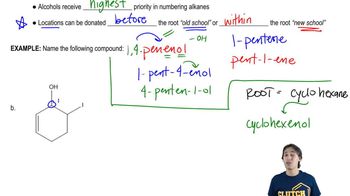
Name the following compound

Skeletal Structures

Skeletal structures are a simplified way of representing organic molecules, where carbon atoms are represented as vertices and hydrogen atoms are implied. This notation omits hydrogen atoms attached to carbons, making it easier to visualize complex molecules. For instance, the skeletal structure of the given compound would show the carbon backbone and any functional groups, such as the bromine atom in the provided image.
추천 영상:
04:03
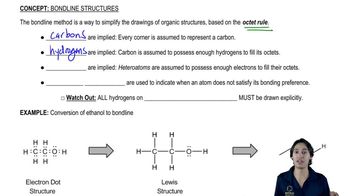
How bondline is different from Lewis Structures.

Condensed Structures

Condensed structures provide a way to represent organic compounds by grouping atoms together to show connectivity without depicting all bonds explicitly. In condensed formulas, atoms are listed in a way that reflects their connectivity, such as CH₃(CH₂)₄CH(CH₃)₂ for the branched alkane. This format is useful for quickly conveying the structure of a compound while still allowing for easy conversion to skeletal structures.
추천 영상:
06:06
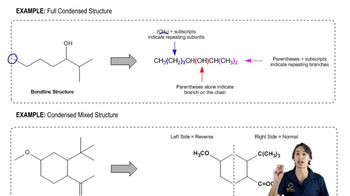
How to interpret condensed structures.