Ch. 3 - An Introduction to Organic Compounds: Nomenclature, Physical Properties, and Structure
Bruice - Organic Chemistry 8th Edition
Bruice8th EditionOrganic ChemistryISBN: 9780135213711당신이 사용하는 게 아니라요?교과서 변경
3장, 문제 77

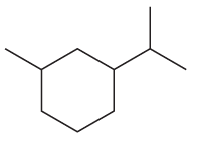
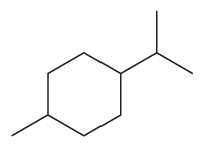
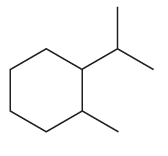
For each of the following compounds, determine whether the cis isomer or the trans isomer is more stable.
a. Chemical structure of a cyclohexane derivative illustrating equatorial and axial positions for stability comparison.
b. Chemical structure of a cyclohexane ring with a substituent, illustrating equatorial and axial positions for stability comparison.
c. Chemical structure of a cyclohexane derivative illustrating equatorial and axial positions for stability comparison.

검증된 단계별 안내
1
Analyze the structure provided: The compound is a substituted cyclohexane with two bulky groups attached to the ring. These groups are located on adjacent carbons, making it a disubstituted cyclohexane.
Understand the cis and trans isomers: In the cis isomer, both substituents are on the same side of the cyclohexane ring (either both axial or both equatorial). In the trans isomer, one substituent is axial and the other is equatorial, placing them on opposite sides of the ring.
Consider steric hindrance: Bulky groups in the axial position experience 1,3-diaxial interactions with other axial hydrogens on the ring. These interactions increase steric strain, making the axial position less favorable for bulky groups.
Evaluate stability: In the trans isomer, one bulky group can occupy the equatorial position, minimizing steric hindrance. In the cis isomer, both bulky groups may occupy axial positions, leading to increased steric strain. Therefore, the trans isomer is generally more stable due to reduced steric interactions.
Conclude: The stability of the isomers depends on the ability of the bulky groups to avoid steric hindrance. For this compound, the trans isomer is likely more stable because it allows one bulky group to occupy the equatorial position, minimizing steric strain.

비슷한 문제에 대한 검증된 영상 답변:

이 영상 해법은 위 문제에 도움이 된다고 튜터들이 추천한 것입니다.
영상 길이:
4m

주요 개념

질문에 올바르게 답하기 위해 반드시 이해해야 하는 핵심 개념들은 다음과 같습니다.

Cis-Trans Isomerism

Cis-trans isomerism, also known as geometric isomerism, occurs in compounds with restricted rotation around a bond, typically in alkenes or cyclic structures. In cis isomers, substituents are on the same side of the double bond or ring, while in trans isomers, they are on opposite sides. This spatial arrangement significantly influences the physical and chemical properties of the compounds, including their stability.
추천 영상:
00:44
Is the following cyclohexane cis or trans?

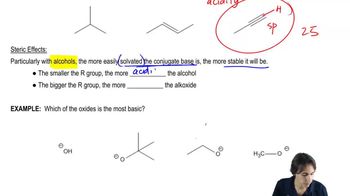
Steric Hindrance

Steric hindrance refers to the repulsion between bulky groups within a molecule that can affect its stability and reactivity. In the context of cis and trans isomers, steric hindrance is often greater in cis isomers due to the proximity of larger substituents, which can lead to increased strain and lower stability compared to trans isomers, where substituents are farther apart.
추천 영상:
02:53
Understanding steric effects.

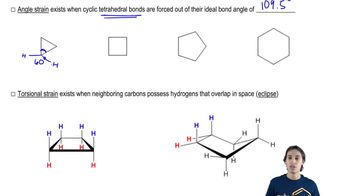
Ring Strain in Cycloalkanes

Ring strain in cycloalkanes arises from the angle strain and torsional strain present in cyclic structures. Cyclohexane, for example, is the most stable due to its ability to adopt a chair conformation that minimizes strain. In the case of cis and trans isomers of cyclohexane derivatives, the conformation adopted by the substituents can significantly impact the overall stability of the molecule, with trans isomers often being more stable due to reduced steric interactions.
추천 영상:
02:46
What is angle strain?