Ch. 3 - An Introduction to Organic Compounds: Nomenclature, Physical Properties, and Structure
Bruice - Organic Chemistry 8th Edition
Bruice8th EditionOrganic ChemistryISBN: 9780135213711당신이 사용하는 게 아니라요?교과서 변경
3장, 문제 51e,f

For each of the following disubstituted cyclohexanes, indicate whether the substituents in the two chair conformers are both equatorial in one chair conformer and both axial in the other or one equatorial and one axial in each of the chair conformers:
e. cis-1,4-
f. trans-1,4-

검증된 단계별 안내
1
Step 1: Understand the problem. We are tasked with analyzing the chair conformations of disubstituted cyclohexanes (cis-1,4- and trans-1,4-) to determine the positions of the substituents (axial or equatorial) in each conformer.
Step 2: Recall the key concepts. In a cyclohexane chair conformation, substituents can occupy either axial (perpendicular to the ring plane) or equatorial (roughly parallel to the ring plane) positions. The relative positions of substituents (cis or trans) determine their placement in the chair conformers.
Step 3: Analyze the cis-1,4-disubstituted cyclohexane. In the cis configuration, the two substituents are on the same side of the ring. For the chair conformers, this means that one substituent will be axial and the other equatorial in both conformers. This is because the 1,4-relationship alternates axial and equatorial positions around the ring.
Step 4: Analyze the trans-1,4-disubstituted cyclohexane. In the trans configuration, the two substituents are on opposite sides of the ring. For the chair conformers, this means that both substituents will be equatorial in one conformer and both will be axial in the other conformer. This is due to the alternating axial and equatorial positions in the 1,4-relationship.
Step 5: Summarize the findings. For cis-1,4-, the substituents are one axial and one equatorial in each conformer. For trans-1,4-, the substituents are both equatorial in one conformer and both axial in the other conformer.

비슷한 문제에 대한 검증된 영상 답변:

이 영상 해법은 위 문제에 도움이 된다고 튜터들이 추천한 것입니다.
영상 길이:
5m

주요 개념

질문에 올바르게 답하기 위해 반드시 이해해야 하는 핵심 개념들은 다음과 같습니다.

Chair Conformation

The chair conformation is the most stable form of cyclohexane, allowing for minimized steric strain. In this conformation, carbon atoms are arranged in a staggered manner, which provides equatorial and axial positions for substituents. Understanding how substituents occupy these positions is crucial for analyzing the stability of disubstituted cyclohexanes.
추천 영상:
03:29
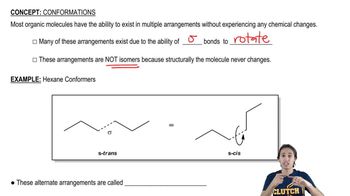
Understanding what a conformer is.

Equatorial vs. Axial Positions

In cyclohexane chair conformations, substituents can occupy equatorial or axial positions. Equatorial substituents extend outward from the ring, minimizing steric hindrance, while axial substituents point vertically, which can lead to 1,3-diaxial interactions and increased steric strain. Identifying these positions is essential for determining the stability of different conformers.
추천 영상:
04:02
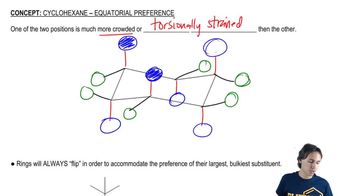
Equatorial Preference

Cis and Trans Isomerism

Cis and trans isomerism refers to the relative positioning of substituents on a cyclohexane ring. In cis isomers, substituents are on the same side of the ring, while in trans isomers, they are on opposite sides. This distinction affects the conformational analysis, as it influences whether substituents can be both equatorial or axial in the chair conformations.
추천 영상:
00:44
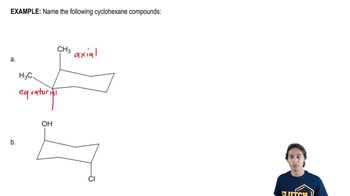
Is the following cyclohexane cis or trans?