Write condensed and skeletal structures for all the tertiary alcohols with molecular formula C6H14O and give each a systematic name.
Ch. 3 - An Introduction to Organic Compounds: Nomenclature, Physical Properties, and Structure
모든 교과서
Bruice 8th Edition
Ch. 3 - An Introduction to Organic Compounds: Nomenclature, Physical Properties, and Structure
문제 27a,b
Bruice 8th Edition
Ch. 3 - An Introduction to Organic Compounds: Nomenclature, Physical Properties, and Structure
문제 27a,b3장, 문제 27a,b
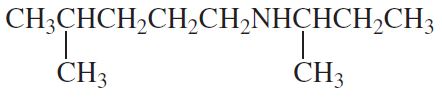
Give a systematic name and a common name (if it has one) for each of the following amines and indicate whether each is a primary, secondary, or tertiary amine:
a. 
b. 
![]()
검증된 단계별 안내1
Step 1: Analyze the structure in part (i). The molecule consists of a straight chain of four carbon atoms with an amino group (-NH₂) attached to the terminal carbon. This indicates it is a primary amine because the nitrogen atom is bonded to only one carbon atom.
Step 2: Assign the systematic name for part (i). The parent chain is butane (four carbons), and the amino group is attached to the first carbon. The systematic name is 1-aminobutane.
Step 3: Determine the common name for part (i). The common name is derived by naming the alkyl group attached to the amino group. The alkyl group is butyl, so the common name is butylamine.
Step 4: Analyze the structure in part (ii). The molecule consists of a chain of four carbon atoms with a methyl group attached to the second carbon and an amino group (-NH) attached to the same second carbon. This indicates it is a secondary amine because the nitrogen atom is bonded to two carbon atoms.
Step 5: Assign the systematic name for part (ii). The parent chain is butane, and the amino group is attached to the second carbon along with a methyl substituent. The systematic name is N-methyl-2-aminobutane. The common name is sec-butylmethylamine.

비슷한 문제에 대한 검증된 영상 답변:
이 영상 해법은 위 문제에 도움이 된다고 튜터들이 추천한 것입니다.
영상 길이:
4m주요 개념
질문에 올바르게 답하기 위해 반드시 이해해야 하는 핵심 개념들은 다음과 같습니다.
Amines
Amines are organic compounds derived from ammonia (NH3) by replacing one or more hydrogen atoms with alkyl or aryl groups. They can be classified as primary (one alkyl group), secondary (two alkyl groups), or tertiary (three alkyl groups) based on the number of carbon-containing groups attached to the nitrogen atom. Understanding the structure of amines is crucial for naming them systematically.
추천 영상:
Reductive Amination
Systematic Naming
Systematic naming of amines follows the IUPAC nomenclature rules, where the longest carbon chain is identified, and the amine functional group is indicated by the suffix '-amine.' For primary amines, the name is derived from the corresponding alkane, while secondary and tertiary amines are named by identifying the substituents attached to the nitrogen atom. This systematic approach ensures clarity and consistency in chemical communication.
추천 영상:
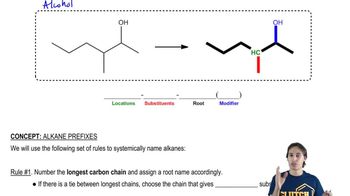
The different parts of an IUPAC name
Common Names
Common names for amines often arise from historical usage and may not follow systematic naming conventions. These names can be based on the structure or the source of the amine, such as 'ethylamine' for a primary amine derived from ethane. Familiarity with common names is important for recognizing and communicating about amines in both academic and practical contexts.
추천 영상:
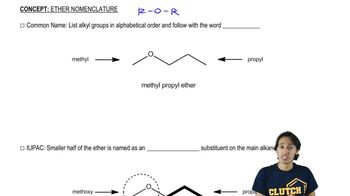
How to name ethers using the common naming system.
관련 실천
교과서 질문
1009
views
교과서 질문
Give a systematic name and a common name (if it has one) for each of the following amines and indicate whether each is a primary, secondary, or tertiary amine:
f.
941
views
교과서 질문
Give each of the following a systematic name and indicate whether each is a primary, secondary, or tertiary alcohol:
c.
d.
842
views
교과서 질문
Give each of the following a systematic name and indicate whether each is a primary, secondary, or tertiary alcohol:
a.
b.
678
views
교과서 질문
Give a systematic name and a common name (if it has one) for each of the following amines and indicate whether each is a primary, secondary, or tertiary amine:
c.
d.
1242
views
교과서 질문
Give a systematic name and a common name (if it has one) for each of the following amines and indicate whether each is a primary, secondary, or tertiary amine:
e.
808
views