Ch. 3 - An Introduction to Organic Compounds: Nomenclature, Physical Properties, and Structure
Bruice - Organic Chemistry 8th Edition
Bruice8th EditionOrganic ChemistryISBN: 9780135213711당신이 사용하는 게 아니라요?교과서 변경
3장, 문제 48d,e,f

Is each of the following a cis isomer or a trans isomer?
d.
e.
f.

검증된 단계별 안내
1
Step 1: Analyze the first structure (d). Identify the substituents on the cyclohexane ring. The bromine (Br) and methyl (CH3) groups are on adjacent carbons. Determine their relative positions (above or below the plane of the ring). If both substituents are on the same side of the ring (either both above or both below), it is a cis isomer. If they are on opposite sides, it is a trans isomer.
Step 2: Analyze the second structure (e). Identify the substituents on the cyclohexane ring. The chlorine (Cl) and methyl (CH3) groups are on adjacent carbons. Determine their relative positions (above or below the plane of the ring). If both substituents are on the same side of the ring (either both above or both below), it is a cis isomer. If they are on opposite sides, it is a trans isomer.
Step 3: Analyze the third structure (f). Identify the substituents on the cyclohexane ring. The two methyl (CH3) groups are on adjacent carbons. Determine their relative positions (above or below the plane of the ring). If both substituents are on the same side of the ring (either both above or both below), it is a cis isomer. If they are on opposite sides, it is a trans isomer.
Step 4: Use the wedge and dash notation in the structures to determine the spatial orientation of the substituents. A wedge indicates a substituent is above the plane of the ring, while a dash indicates it is below the plane of the ring.
Step 5: Based on the spatial orientation of the substituents in each structure, classify each as either cis or trans. Remember, cis isomers have substituents on the same side of the ring, while trans isomers have substituents on opposite sides.

비슷한 문제에 대한 검증된 영상 답변:

이 영상 해법은 위 문제에 도움이 된다고 튜터들이 추천한 것입니다.

주요 개념

질문에 올바르게 답하기 위해 반드시 이해해야 하는 핵심 개념들은 다음과 같습니다.

Cis-Trans Isomerism

Cis-trans isomerism, also known as geometric isomerism, occurs in compounds with restricted rotation around a double bond or a ring structure. In cis isomers, substituents are on the same side of the double bond or ring, while in trans isomers, they are on opposite sides. This spatial arrangement can significantly affect the physical and chemical properties of the molecules.
추천 영상:
00:44
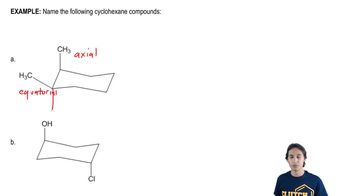
Is the following cyclohexane cis or trans?

Identification of Isomers

To determine whether a compound is a cis or trans isomer, one must analyze the arrangement of substituents around the double bond or ring. This involves identifying the priority of the groups attached to the carbons involved in the double bond, using the Cahn-Ingold-Prelog priority rules. The configuration can then be classified based on the relative positions of these groups.
추천 영상:
01:10
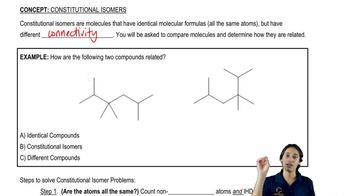
What is a constitutional isomer?

Impact of Isomerism on Properties

Cis and trans isomers can exhibit different physical properties, such as boiling points, melting points, and solubility. For example, cis isomers often have higher boiling points due to increased polarity, while trans isomers may be more stable and have lower boiling points. Understanding these differences is crucial for predicting the behavior of these compounds in chemical reactions and applications.
추천 영상:
06:47
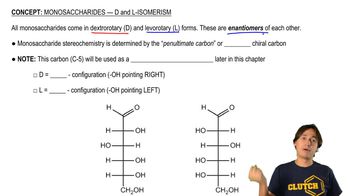
Monosaccharides - D and L Isomerism