Ch. 3 - An Introduction to Organic Compounds: Nomenclature, Physical Properties, and Structure
Bruice - Organic Chemistry 8th Edition
Bruice8th EditionOrganic ChemistryISBN: 9780135213711당신이 사용하는 게 아니라요?교과서 변경
3장, 문제 31d

Predict the approximate size of the following bond angles.
(d) the C—N—C bond angle in a quaternary ammonium salt

검증된 단계별 안내
1
Review the structure of a quaternary ammonium salt. A quaternary ammonium salt has a central nitrogen atom bonded to four alkyl or aryl groups and carries a positive charge. The nitrogen is sp³ hybridized, meaning it forms four sigma bonds.
Recall the ideal bond angles for sp³ hybridized atoms. In an sp³ hybridized geometry, the electron pairs are arranged in a tetrahedral shape to minimize electron pair repulsion. The ideal bond angle for a tetrahedral geometry is approximately 109.5°.
Consider the effect of the positive charge on the nitrogen atom. The positive charge does not significantly alter the geometry because all four substituents are bonded to the nitrogen atom, and there are no lone pairs to cause additional repulsion.
Compare this situation to other sp³ hybridized atoms. Since there are no lone pairs on the nitrogen atom in a quaternary ammonium salt, the bond angles are expected to be close to the ideal tetrahedral angle of 109.5°.
Conclude that the C—N—C bond angle in a quaternary ammonium salt is approximately 109.5°, as the geometry is determined by the sp³ hybridization and the absence of lone pairs on the nitrogen atom.

비슷한 문제에 대한 검증된 영상 답변:

이 영상 해법은 위 문제에 도움이 된다고 튜터들이 추천한 것입니다.
영상 길이:
2m

주요 개념

질문에 올바르게 답하기 위해 반드시 이해해야 하는 핵심 개념들은 다음과 같습니다.

Hybridization

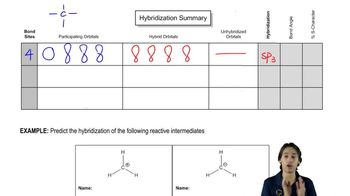
Hybridization is the concept of mixing atomic orbitals to form new hybrid orbitals that can accommodate bonding. In the case of quaternary ammonium salts, the nitrogen atom typically undergoes sp³ hybridization, leading to the formation of four equivalent sp³ hybrid orbitals that arrange themselves in a tetrahedral geometry.
추천 영상:
10:43
Using bond sites to predict hybridization

Bond Angles

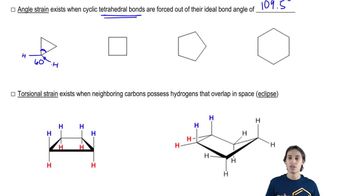
Bond angles are the angles formed between two bonds that share a common atom. In a tetrahedral arrangement, such as that found in quaternary ammonium salts, the ideal bond angle is approximately 109.5 degrees. However, the presence of different substituents can slightly alter these angles.
추천 영상:
02:46
What is angle strain?

Steric Effects

Steric effects refer to the influence of the spatial arrangement of atoms on the reactivity and stability of a molecule. In quaternary ammonium salts, the bulky alkyl groups attached to the nitrogen can create steric hindrance, which may affect the bond angles slightly, but the overall tetrahedral geometry remains dominant.
추천 영상:
02:53
Understanding steric effects.