Ch. 3 - An Introduction to Organic Compounds: Nomenclature, Physical Properties, and Structure
Bruice - Organic Chemistry 8th Edition
Bruice8th EditionOrganic ChemistryISBN: 9780135213711당신이 사용하는 게 아니라요?교과서 변경
3장, 문제 44

Verify the strain energy shown in Table 3.8 for cycloheptane

검증된 단계별 안내
1
Step 1: Understand the concept of strain energy. Strain energy in cycloalkanes arises due to factors like angle strain (deviation from ideal bond angles), torsional strain (eclipsing interactions), and steric strain (crowding of atoms). Cycloheptane, being a medium-sized ring, experiences strain due to its non-ideal conformations.
Step 2: Review the conformations of cycloheptane. Cycloheptane adopts a puckered, non-planar conformation to minimize strain. Analyze the bond angles and torsional interactions in this conformation to identify sources of strain energy.
Step 3: Use experimental or calculated data to determine the strain energy. Strain energy is typically derived from heats of combustion or computational methods. Compare the experimental heat of combustion per CH₂ group for cycloheptane with that of an unstrained alkane to calculate the strain energy.
Step 4: Apply the formula for strain energy calculation. Strain energy can be calculated as the difference between the experimental heat of combustion and the theoretical heat of combustion for a strain-free molecule. Represent this calculation using MathML: Strain Energy=Heat of Combustion (Experimental)-Heat of Combustion (Theoretical)
Step 5: Verify the strain energy value in Table 3.8. Compare your calculated strain energy with the value provided in the table. Ensure consistency by checking the methodology used to derive the table value and confirm that it aligns with your approach.

비슷한 문제에 대한 검증된 영상 답변:

이 영상 해법은 위 문제에 도움이 된다고 튜터들이 추천한 것입니다.
영상 길이:
2m

주요 개념

질문에 올바르게 답하기 위해 반드시 이해해야 하는 핵심 개념들은 다음과 같습니다.

Strain Energy

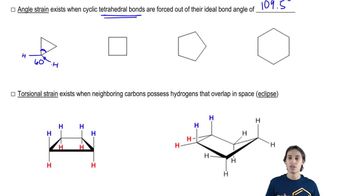
Strain energy in organic chemistry refers to the energy stored in a molecule due to the distortion of its bond angles and lengths from their ideal values. In cyclic compounds, such as cycloheptane, strain arises from angle strain, torsional strain, and steric hindrance, which can affect the stability and reactivity of the molecule. Understanding strain energy is crucial for predicting the behavior of cyclic compounds.
추천 영상:
02:46
What is angle strain?

Cycloheptane Structure

Cycloheptane is a seven-membered carbon ring that exhibits unique structural characteristics compared to smaller cycloalkanes. Its non-planar conformation helps alleviate some strain, but it still experiences significant angle strain due to the deviation from the ideal tetrahedral bond angles of 109.5 degrees. Familiarity with cycloheptane's structure is essential for analyzing its strain energy.
추천 영상:
03:04
Drawing Resonance Structures

Table of Strain Energies

Tables of strain energies provide quantitative values that represent the stability of various cyclic compounds, including cycloheptane. These values are derived from experimental data and theoretical calculations, allowing chemists to compare the relative strain of different rings. Analyzing such tables helps in understanding how molecular structure influences strain and, consequently, the compound's reactivity and stability.
추천 영상:
02:46
What is angle strain?