Ch. 3 - An Introduction to Organic Compounds: Nomenclature, Physical Properties, and Structure
Bruice - Organic Chemistry 8th Edition
Bruice8th EditionOrganic ChemistryISBN: 9780135213711당신이 사용하는 게 아니라요?교과서 변경
3장, 문제 6

Which of the following statements can be used to prove that carbon is tetrahedral?
a. CH3Br does not have constitutional isomers.
b. CBr4 does not have a dipole moment.
c. CH2Br2 does not have constitutional isomers.

검증된 단계별 안내
1
Step 1: Understand the concept of tetrahedral geometry. Carbon forms four single bonds in a tetrahedral arrangement due to sp3 hybridization. This geometry minimizes electron repulsion and is a fundamental property of carbon in organic molecules.
Step 2: Analyze statement (a): CH3Br does not have constitutional isomers. Constitutional isomers differ in the connectivity of atoms. Since CH3Br has a single carbon atom bonded to three hydrogens and one bromine, there is no alternative connectivity possible, supporting the tetrahedral nature of carbon.
Step 3: Analyze statement (b): CBr4 does not have a dipole moment. In a tetrahedral molecule like CBr4, the symmetry cancels out any dipole moments from the individual C-Br bonds, resulting in a nonpolar molecule. This is consistent with the tetrahedral geometry of carbon.
Step 4: Analyze statement (c): CH2Br2 does not have constitutional isomers. CH2Br2 has one carbon atom bonded to two hydrogens and two bromines. The tetrahedral arrangement ensures that there is no alternative connectivity possible, supporting the tetrahedral nature of carbon.
Step 5: Conclude that all three statements (a, b, and c) provide evidence for the tetrahedral geometry of carbon. Each statement highlights a property or behavior that is consistent with the sp3 hybridization and tetrahedral arrangement of carbon atoms in organic molecules.

비슷한 문제에 대한 검증된 영상 답변:

이 영상 해법은 위 문제에 도움이 된다고 튜터들이 추천한 것입니다.
영상 길이:
7m

주요 개념

질문에 올바르게 답하기 위해 반드시 이해해야 하는 핵심 개념들은 다음과 같습니다.

Tetrahedral Geometry

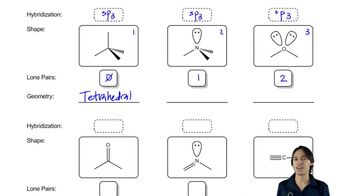
Tetrahedral geometry refers to the three-dimensional arrangement of atoms around a central atom, where four substituents are positioned at the corners of a tetrahedron. In organic chemistry, carbon typically exhibits this geometry when it forms four single bonds, as seen in methane (CH4). This spatial arrangement minimizes electron pair repulsion, leading to a stable molecular structure.
추천 영상:
07:44
Molecular Geometry Explained.

Constitutional Isomers

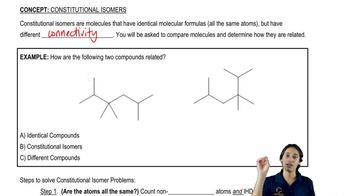
Constitutional isomers are compounds that have the same molecular formula but differ in the connectivity of their atoms. This concept is crucial in organic chemistry as it helps in understanding the diversity of organic compounds. The presence or absence of constitutional isomers can indicate the degree of symmetry and the types of bonds present in a molecule, which can relate to the geometry of carbon.
추천 영상:
01:10
What is a constitutional isomer?

Dipole Moment

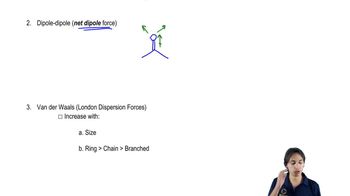
A dipole moment is a measure of the separation of positive and negative charges in a molecule, which results from differences in electronegativity between bonded atoms. In tetrahedral molecules like carbon compounds, the symmetry of the structure can lead to a cancellation of dipole moments, resulting in a nonpolar molecule. Understanding dipole moments is essential for predicting molecular behavior and interactions.
추천 영상:
01:46
How dipole-dipole forces work.