Ch. 4 - Isomers: The Arrangement of Atoms in Space
Bruice - Organic Chemistry 8th Edition
Bruice8th EditionOrganic ChemistryISBN: 9780135213711당신이 사용하는 게 아니라요?교과서 변경
4장, 문제 51e,f

Draw all the stereoisomers for each of the following:
e. 3,4-dichlorohexane
f. 1,2-dichlorocyclobutane

검증된 단계별 안내
1
Step 1: Understand the concept of stereoisomers. Stereoisomers are compounds with the same molecular formula and connectivity of atoms but differ in the spatial arrangement of atoms. For molecules with chiral centers, stereoisomers can be classified as enantiomers (non-superimposable mirror images) or diastereomers (non-mirror image stereoisomers).
Step 2: Analyze the structure of 3,4-dichlorohexane. Identify the chiral centers in the molecule. A chiral center is a carbon atom bonded to four different groups. In 3,4-dichlorohexane, the carbons at positions 3 and 4 are chiral centers because they are bonded to a chlorine atom, a hydrogen atom, and two different alkyl groups.
Step 3: Determine the number of stereoisomers for 3,4-dichlorohexane. The formula for calculating the number of stereoisomers is 2^n, where n is the number of chiral centers. Since there are two chiral centers in 3,4-dichlorohexane, there will be 2^2 = 4 stereoisomers. These include two pairs of enantiomers.
Step 4: Analyze the structure of 1,2-dichlorocyclobutane. Identify the chiral centers and the potential for cis-trans isomerism. In cyclobutane, the carbons at positions 1 and 2 are bonded to chlorine atoms, and the ring structure restricts rotation, leading to cis (both chlorine atoms on the same side of the ring) and trans (chlorine atoms on opposite sides of the ring) isomers. Additionally, if the molecule has chiral centers, further stereoisomers may exist.
Step 5: Draw all stereoisomers for both compounds. For 3,4-dichlorohexane, draw the four stereoisomers by assigning R/S configurations to the chiral centers. For 1,2-dichlorocyclobutane, draw the cis and trans isomers, and if chiral centers are present, assign R/S configurations to generate additional stereoisomers. Ensure that all drawings clearly depict the spatial arrangement of atoms.

비슷한 문제에 대한 검증된 영상 답변:

이 영상 해법은 위 문제에 도움이 된다고 튜터들이 추천한 것입니다.
영상 길이:
4m

주요 개념

질문에 올바르게 답하기 위해 반드시 이해해야 하는 핵심 개념들은 다음과 같습니다.

Stereoisomerism

Stereoisomerism refers to the phenomenon where compounds have the same molecular formula and connectivity of atoms but differ in the spatial arrangement of their atoms. This can lead to different physical and chemical properties. The two main types of stereoisomers are enantiomers, which are non-superimposable mirror images, and diastereomers, which are not mirror images of each other.
추천 영상:
01:58
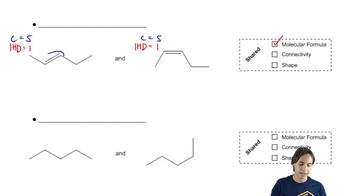
Determining when molecules are stereoisomers.

Chirality

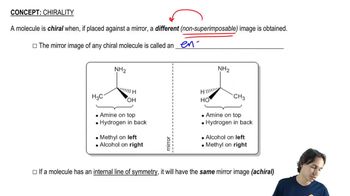
Chirality is a property of a molecule that makes it non-superimposable on its mirror image, often due to the presence of a chiral center, typically a carbon atom bonded to four different substituents. In the context of stereoisomers, chiral molecules can exist as two enantiomers, which can have significantly different biological activities. Identifying chiral centers is crucial for determining the number of stereoisomers.
추천 영상:
05:10
What is chirality?

Cyclic Compounds and Ring Strain

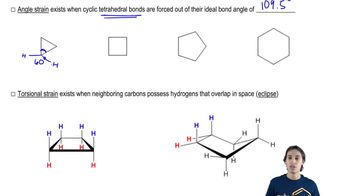
Cyclic compounds, such as cyclobutane, can exhibit unique stereochemical properties due to their ring structure. Ring strain occurs when the bond angles deviate from the ideal tetrahedral angle of 109.5 degrees, which can affect the stability and reactivity of the compound. Understanding the geometry and potential for stereoisomerism in cyclic compounds is essential for drawing all possible stereoisomers.
추천 영상:
02:46
What is angle strain?