Ch. 4 - Isomers: The Arrangement of Atoms in Space
Bruice - Organic Chemistry 8th Edition
Bruice8th EditionOrganic ChemistryISBN: 9780135213711당신이 사용하는 게 아니라요?교과서 변경
4장, 문제 95

Explain why the enantiomers of 1,2-dimethylaziridine can be separated even though one of the “groups” attached to nitrogen is a lone pair.
<IMAGE>

검증된 단계별 안내
1
Step 1: Recognize that 1,2-dimethylaziridine is a chiral molecule due to the presence of a stereogenic nitrogen atom. The nitrogen atom is bonded to three distinct groups: a methyl group, another methyl group attached to the aziridine ring, and a lone pair of electrons.
Step 2: Understand that the lone pair of electrons on nitrogen can act as a 'group' in determining chirality. This is because the spatial arrangement of the lone pair relative to the other substituents creates a non-superimposable mirror image, leading to enantiomers.
Step 3: Note that nitrogen inversion (the flipping of the lone pair through the plane of the molecule) is typically fast in many amines, which would make enantiomers indistinguishable. However, in the case of aziridines, the ring strain significantly slows down nitrogen inversion, allowing the enantiomers to exist as distinct, separable entities.
Step 4: Consider the physical and chemical properties of the enantiomers. Since enantiomers are non-superimposable mirror images, they will interact differently with chiral environments, such as polarized light or chiral reagents, enabling their separation.
Step 5: Conclude that the enantiomers of 1,2-dimethylaziridine can be separated because the nitrogen inversion is hindered by the strain of the aziridine ring, preserving the chirality and allowing the enantiomers to exist as stable, separable forms.

비슷한 문제에 대한 검증된 영상 답변:

이 영상 해법은 위 문제에 도움이 된다고 튜터들이 추천한 것입니다.
영상 길이:
3m

주요 개념

질문에 올바르게 답하기 위해 반드시 이해해야 하는 핵심 개념들은 다음과 같습니다.

Enantiomers

Enantiomers are a type of stereoisomer that are non-superimposable mirror images of each other. They typically arise in chiral molecules, which have at least one carbon atom bonded to four different substituents. In the case of 1,2-dimethylaziridine, the presence of chiral centers leads to the formation of two distinct enantiomers, each exhibiting different spatial arrangements.
추천 영상:
03:23
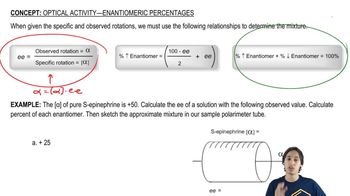
How to solve for the percentage of each enantiomer.

Chirality and Stereocenters

Chirality refers to the geometric property of a molecule that makes it non-superimposable on its mirror image. A stereocenter, often a carbon atom, is bonded to four different groups, creating chirality. In 1,2-dimethylaziridine, the nitrogen atom can also contribute to chirality due to its lone pair, which can influence the spatial arrangement of the attached groups.
추천 영상:
02:25
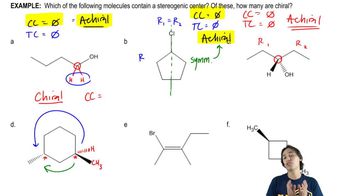
Determining Chirality using Stereocenter

Separation of Enantiomers

Enantiomers can be separated through techniques such as chiral chromatography or by using chiral resolving agents. The unique spatial arrangement of the enantiomers allows them to interact differently with other chiral substances, enabling their separation. In the case of 1,2-dimethylaziridine, the lone pair on nitrogen can create a distinct environment that aids in the differentiation and separation of the enantiomers.
추천 영상:
03:23
How to solve for the percentage of each enantiomer.