Ch. 4 - Isomers: The Arrangement of Atoms in Space
Bruice - Organic Chemistry 8th Edition
Bruice8th EditionOrganic ChemistryISBN: 9780135213711당신이 사용하는 게 아니라요?교과서 변경
4장, 문제 48

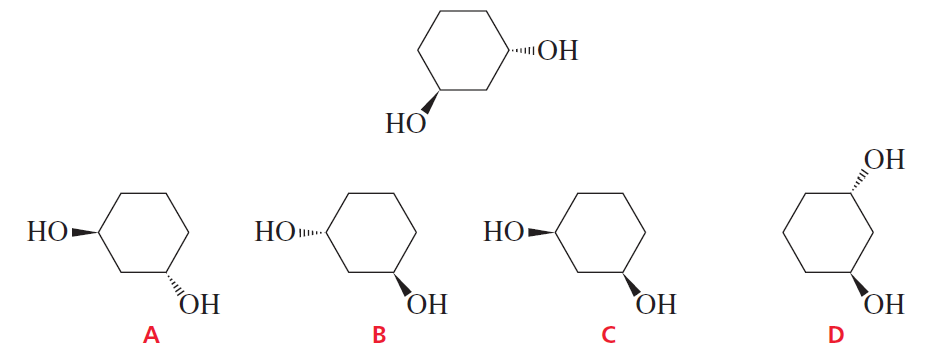
Indicate whether each of the structures in the second row is an enantiomer of, is a diastereomer of, or is identical to the structure in the top row.
Structures A, B, C, and D are compared to the top structure, indicating their relationships as enantiomers or diastereomers.

검증된 단계별 안내
1
Step 1: Analyze the structure in the top row (reference structure). It is a cyclohexane ring with two substituents: one wedge bond (indicating a substituent coming out of the plane) and one dashed bond (indicating a substituent going into the plane). This configuration establishes the stereochemistry of the reference structure.
Step 2: Compare structure (a) to the reference structure. Structure (a) has the same substituents but the stereochemistry is reversed (the wedge and dashed bonds are swapped). This indicates that structure (a) is an enantiomer of the reference structure.
Step 3: Compare structure (b) to the reference structure. Structure (b) has one substituent with the same stereochemistry as the reference structure and the other substituent with reversed stereochemistry. This indicates that structure (b) is a diastereomer of the reference structure.
Step 4: Compare structure (c) to the reference structure. Structure (c) has both substituents on wedge bonds, which is different from the stereochemistry of the reference structure. This indicates that structure (c) is a diastereomer of the reference structure.
Step 5: Compare structure (d) to the reference structure. Structure (d) has the same substituents and the same stereochemistry (one wedge bond and one dashed bond in the same positions). This indicates that structure (d) is identical to the reference structure.

비슷한 문제에 대한 검증된 영상 답변:

이 영상 해법은 위 문제에 도움이 된다고 튜터들이 추천한 것입니다.
영상 길이:
6m

주요 개념

질문에 올바르게 답하기 위해 반드시 이해해야 하는 핵심 개념들은 다음과 같습니다.

Stereoisomerism

Stereoisomerism refers to the phenomenon where compounds have the same molecular formula and connectivity of atoms but differ in the spatial arrangement of their atoms. This can lead to different physical and chemical properties. The two main types of stereoisomers are enantiomers, which are non-superimposable mirror images, and diastereomers, which are not mirror images of each other.
추천 영상:
01:58
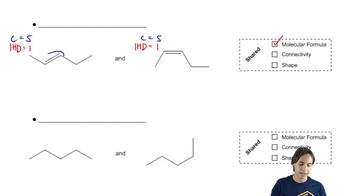
Determining when molecules are stereoisomers.

Enantiomers

Enantiomers are a specific type of stereoisomer that are mirror images of each other and cannot be superimposed. They typically arise in molecules with chiral centers, where the arrangement of substituents around the chiral center leads to two distinct configurations. Enantiomers often exhibit different optical activities, meaning they rotate plane-polarized light in opposite directions.
추천 영상:
03:23
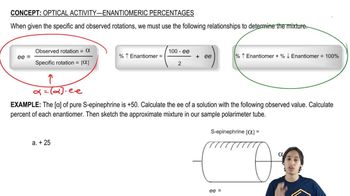
How to solve for the percentage of each enantiomer.

Diastereomers

Diastereomers are stereoisomers that are not mirror images of each other. They occur when a molecule has two or more chiral centers, leading to multiple configurations that differ at one or more chiral centers but not all. Unlike enantiomers, diastereomers can have different physical properties, such as boiling points and solubilities, making them easier to separate and identify.
추천 영상:
03:44
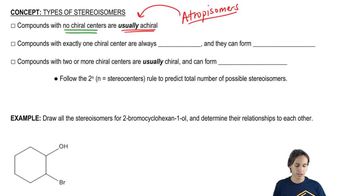
Using chiral centers to predict types of stereoisomers.