
Ch. 4 - Isomers: The Arrangement of Atoms in Space
Bruice - Organic Chemistry 8th Edition
Bruice8th EditionOrganic ChemistryISBN: 9780135213711당신이 사용하는 게 아니라요?교과서 변경
4장, 문제 83

The specific rotation of (R)-(+)-glyceraldehyde is +8.7. If the observed specific rotation of a mixture of (R)-glyceraldehyde and (S)-glyceraldehyde is +1.4, what percent of glyceraldehyde is present as the R enantiomer?

검증된 단계별 안내
1
Step 1: Recall the formula for calculating the observed specific rotation of a mixture: \( \text{[α]}_{\text{obs}} = \text{[α]}_{\text{R}} \cdot \text{fraction}_{\text{R}} + \text{[α]}_{\text{S}} \cdot \text{fraction}_{\text{S}} \). Here, \( \text{[α]}_{\text{R}} \) is the specific rotation of the R enantiomer, \( \text{[α]}_{\text{S}} \) is the specific rotation of the S enantiomer, and \( \text{fraction}_{\text{R}} + \text{fraction}_{\text{S}} = 1 \).
Step 2: Substitute the given values into the formula. The specific rotation of (R)-(+)-glyceraldehyde is \( +8.7 \), and the observed specific rotation of the mixture is \( +1.4 \). Since the S enantiomer is the opposite of the R enantiomer, \( \text{[α]}_{\text{S}} = -8.7 \). The equation becomes \( +1.4 = (+8.7 \cdot \text{fraction}_{\text{R}}) + (-8.7 \cdot \text{fraction}_{\text{S}}) \).
Step 3: Replace \( \text{fraction}_{\text{S}} \) with \( 1 - \text{fraction}_{\text{R}} \) because the sum of the fractions of the R and S enantiomers must equal 1. The equation now becomes \( +1.4 = (+8.7 \cdot \text{fraction}_{\text{R}}) + (-8.7 \cdot (1 - \text{fraction}_{\text{R}})) \).
Step 4: Simplify the equation by distributing \( -8.7 \) across \( (1 - \text{fraction}_{\text{R}}) \). This results in \( +1.4 = (+8.7 \cdot \text{fraction}_{\text{R}}) - 8.7 + (8.7 \cdot \text{fraction}_{\text{R}}) \). Combine like terms to get \( +1.4 = 17.4 \cdot \text{fraction}_{\text{R}} - 8.7 \).
Step 5: Solve for \( \text{fraction}_{\text{R}} \) by isolating it on one side of the equation. Add \( 8.7 \) to both sides and then divide by \( 17.4 \). Once \( \text{fraction}_{\text{R}} \) is determined, multiply it by 100 to find the percentage of glyceraldehyde present as the R enantiomer.

비슷한 문제에 대한 검증된 영상 답변:

이 영상 해법은 위 문제에 도움이 된다고 튜터들이 추천한 것입니다.
영상 길이:
4m

주요 개념

질문에 올바르게 답하기 위해 반드시 이해해야 하는 핵심 개념들은 다음과 같습니다.

Specific Rotation

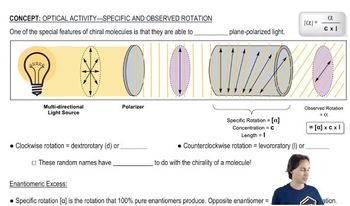
Specific rotation is a measure of how much a chiral compound rotates plane-polarized light, expressed in degrees. It is defined as the observed rotation divided by the concentration of the solution and the path length of the light. This property is crucial for distinguishing between enantiomers, as each enantiomer will rotate light in opposite directions.
추천 영상:
05:43
Specific rotation vs. observed rotation.

Enantiomers

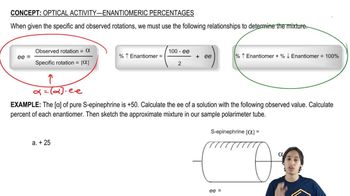
Enantiomers are pairs of molecules that are non-superimposable mirror images of each other, often differing in their optical activity. In the case of glyceraldehyde, (R)-glyceraldehyde and (S)-glyceraldehyde are enantiomers, with distinct specific rotations. Understanding the relationship between enantiomers is essential for calculating the composition of a mixture based on its observed specific rotation.
추천 영상:
03:23
How to solve for the percentage of each enantiomer.

Optical Purity

Optical purity is a measure of the proportion of one enantiomer in a mixture relative to the total amount of both enantiomers. It can be calculated using the formula: optical purity = (observed specific rotation / specific rotation of pure enantiomer) × 100%. This concept is vital for determining the percentage of the (R)-glyceraldehyde in the mixture based on the observed specific rotation.
추천 영상:
08:17
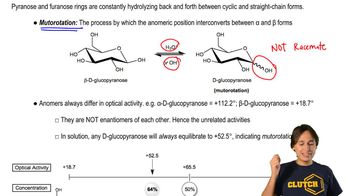
Mutarotation and Optical Activity