Using the wedge-and-dash notation, draw the nine stereoisomers of 1,2,3,4,5,6-hexachlorocyclohexane.
Ch. 4 - Isomers: The Arrangement of Atoms in Space
4장, 문제 99c
What is the configuration of each of the asymmetric centers in the following compounds?
c. 
검증된 단계별 안내1
Step 1: Identify the asymmetric center in the molecule. An asymmetric center is a carbon atom bonded to four different groups. In this case, the carbon atom in the cyclobutane ring is bonded to an -OH group, a -Br group, a hydrogen atom, and the rest of the cyclobutane ring.
Step 2: Assign priorities to the substituents attached to the asymmetric center based on the Cahn-Ingold-Prelog (CIP) priority rules. The priority is determined by the atomic number of the atoms directly attached to the asymmetric center. Bromine (Br) has the highest priority (atomic number 35), followed by oxygen (O) in the -OH group (atomic number 8), then the carbon in the cyclobutane ring, and finally hydrogen (H) with the lowest priority (atomic number 1).
Step 3: Orient the molecule so that the substituent with the lowest priority (hydrogen) is pointing away from you (on the dashed wedge). This orientation is crucial for determining the configuration.
Step 4: Determine the order of the remaining substituents (1 → 2 → 3) in a clockwise or counterclockwise direction. If the sequence is clockwise, the configuration is R. If the sequence is counterclockwise, the configuration is S.
Step 5: Based on the analysis, assign the configuration (R or S) to the asymmetric center. Ensure that the orientation and priority rules are applied correctly to arrive at the configuration.

비슷한 문제에 대한 검증된 영상 답변:
이 영상 해법은 위 문제에 도움이 된다고 튜터들이 추천한 것입니다.
영상 길이:
2m주요 개념
질문에 올바르게 답하기 위해 반드시 이해해야 하는 핵심 개념들은 다음과 같습니다.
Asymmetric Centers
Asymmetric centers, or chiral centers, are carbon atoms bonded to four different substituents, leading to non-superimposable mirror images known as enantiomers. Identifying these centers is crucial for determining the stereochemistry of a compound, as the spatial arrangement of substituents affects the compound's properties and reactivity.
추천 영상:
How to add to asymmetrical double bonds.
Cahn-Ingold-Prelog Priority Rules
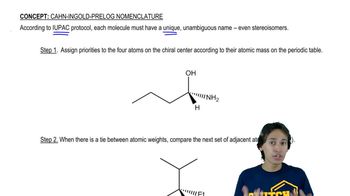
The Cahn-Ingold-Prelog (CIP) priority rules are a set of guidelines used to assign priorities to substituents attached to chiral centers. By comparing the atomic numbers of the atoms directly bonded to the chiral carbon, one can determine the order of priority, which is essential for assigning the R or S configuration to the asymmetric centers.
추천 영상:
Why stereoisomers need their own naming system.
Stereochemistry
Stereochemistry is the study of the spatial arrangement of atoms in molecules and how this arrangement affects their chemical behavior. Understanding stereochemistry is vital for predicting the interactions and reactions of chiral compounds, as different configurations can lead to vastly different biological activities and properties.
추천 영상:
가이드 코스
Polymer Stereochemistry Concept 1
관련 실천
교과서 질문
1909
views
교과서 질문
A student decided that the configuration of the asymmetric centers in a sugar such as D-glucose could be determined rapidly by simply assigning the R configuration to an symmetric center with an OH group on the right and the S configuration to an symmetric center with an OH group on the left. Is he correct?
1099
views
교과서 질문
A sample of (S)-(+)-lactic acid was found to have an enantiomeric excess of 72%. How much R isomer is present in the sample?
1188
views
교과서 질문
Tamiflu is used for the prevention and treatment of flu. What is the configuration of each of its asymmetric centers?
2044
views
교과서 질문
Draw the two chair conformers for each of the stereoisomers of trans-1-tert-butyl-3-methylcyclohexane.
1442
views
교과서 질문
From the nine stereoisomers, identify one pair of enantiomers.
1319
views