Ch. 5 - Alkenes: Structure, Nomenclature, and an Introduction to Reactivity • Thermodynamics and Kinetics
Bruice - Organic Chemistry 8th Edition
Bruice8th EditionOrganic ChemistryISBN: 9780135213711당신이 사용하는 게 아니라요?교과서 변경
5장, 문제 22

a. For a reaction with ∆H° = -12 kcal/mol and ∆S° = 0.01 kcal mol-1 K-1, calculate the ∆G° and the equilibrium constant at:
1. 30 °C and 2. 150 °C.
b. How does ∆G° change as T increases?
c. How does Keq change as T increases?

검증된 단계별 안내
1
Step 1: Recall the Gibbs free energy equation: ΔG° = ΔH° - TΔS°. Here, ΔH° is the enthalpy change, ΔS° is the entropy change, and T is the temperature in Kelvin. Convert the given temperatures (30 °C and 150 °C) to Kelvin using the formula T(K) = T(°C) + 273.
Step 2: For part (a), calculate ΔG° at each temperature using the Gibbs free energy equation. Substitute the values of ΔH° (-12 kcal/mol), ΔS° (0.01 kcal/mol·K), and the respective temperatures in Kelvin into the equation. Perform the subtraction to find ΔG° for each temperature.
Step 3: To calculate the equilibrium constant (Keq), use the relationship between ΔG° and Keq: ΔG° = -RT ln(Keq), where R is the gas constant (0.001987 kcal/mol·K). Rearrange the equation to solve for Keq: Keq = e^(-ΔG°/RT). Substitute the values of ΔG°, R, and T for each temperature to find Keq.
Step 4: For part (b), analyze how ΔG° changes as T increases. Since ΔG° = ΔH° - TΔS°, observe that the term TΔS° becomes larger as T increases. If ΔS° is positive, the magnitude of ΔG° decreases (becomes less negative or more positive) as T increases.
Step 5: For part (c), analyze how Keq changes as T increases. Since Keq = e^(-ΔG°/RT), if ΔG° becomes less negative or more positive as T increases, the exponent (-ΔG°/RT) becomes smaller, leading to a decrease in Keq. Conversely, if ΔG° becomes more negative, Keq increases.

비슷한 문제에 대한 검증된 영상 답변:

이 영상 해법은 위 문제에 도움이 된다고 튜터들이 추천한 것입니다.
영상 길이:
8m

주요 개념

질문에 올바르게 답하기 위해 반드시 이해해야 하는 핵심 개념들은 다음과 같습니다.

Gibbs Free Energy (∆G°)

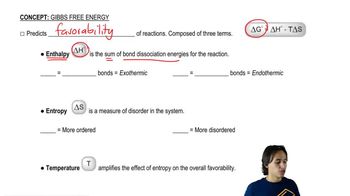
Gibbs Free Energy (∆G°) is a thermodynamic potential that measures the maximum reversible work obtainable from a thermodynamic system at constant temperature and pressure. It is calculated using the equation ∆G° = ∆H° - T∆S°, where ∆H° is the change in enthalpy, T is the temperature in Kelvin, and ∆S° is the change in entropy. A negative ∆G° indicates a spontaneous reaction, while a positive value suggests non-spontaneity.
추천 영상:
05:02
Breaking down the different terms of the Gibbs Free Energy equation.

Equilibrium Constant (Keq)

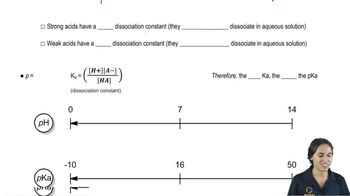
The equilibrium constant (Keq) quantifies the ratio of the concentrations of products to reactants at equilibrium for a reversible reaction. It is related to Gibbs Free Energy by the equation ∆G° = -RT ln(Keq), where R is the universal gas constant and T is the temperature in Kelvin. Changes in temperature can affect Keq, as they influence the position of equilibrium and the favorability of the reaction.
추천 영상:
02:19
The relationship between equilibrium constant and pKa.

Temperature Dependence of ∆G° and Keq

The temperature dependence of Gibbs Free Energy (∆G°) and the equilibrium constant (Keq) is significant in thermodynamics. As temperature increases, the term T∆S° becomes more influential in the Gibbs Free Energy equation, potentially leading to a decrease in ∆G° if ∆S° is positive. Consequently, an increase in temperature can shift the equilibrium constant (Keq), favoring the formation of products or reactants depending on the sign of ∆H° and ∆S°.
추천 영상:
가이드 코스
1:44
Polymers Structure and Properties Concept 3