Ch. 5 - Alkenes: Structure, Nomenclature, and an Introduction to Reactivity • Thermodynamics and Kinetics
Bruice - Organic Chemistry 8th Edition
Bruice8th EditionOrganic ChemistryISBN: 9780135213711당신이 사용하는 게 아니라요?교과서 변경
5장, 문제 42a,b,c

Draw the condensed structure for each of the following:
a. (Z)-1,3,5-tribromo-2-pentene
b. (Z)-3-methyl-2-heptene
c. (E)-1,2-dibromo-3-isopropyl-2-hexene

검증된 단계별 안내
1
Step 1: Understand the nomenclature and stereochemistry. The prefixes (Z) and (E) refer to the stereochemistry of the double bond. (Z) means the higher-priority groups on each carbon of the double bond are on the same side, while (E) means they are on opposite sides. Identify the substituents and their positions based on the name provided.
Step 2: For part (a), (Z)-1,3,5-tribromo-2-pentene: Start by drawing the pentene backbone (five carbons with a double bond between C2 and C3). Add bromine atoms at positions C1, C3, and C5. Ensure the (Z) configuration by placing the higher-priority groups (bromine atoms) on the same side of the double bond.
Step 3: For part (b), (Z)-3-methyl-2-heptene: Begin by drawing the heptene backbone (seven carbons with a double bond between C2 and C3). Add a methyl group at position C3. Ensure the (Z) configuration by placing the higher-priority groups (the methyl group and the longer carbon chain) on the same side of the double bond.
Step 4: For part (c), (E)-1,2-dibromo-3-isopropyl-2-hexene: Start by drawing the hexene backbone (six carbons with a double bond between C2 and C3). Add bromine atoms at positions C1 and C2, and an isopropyl group at position C3. Ensure the (E) configuration by placing the higher-priority groups (bromine atoms and the isopropyl group) on opposite sides of the double bond.
Step 5: Verify the condensed structures by ensuring all substituents are correctly placed, the stereochemistry matches the (Z) or (E) designation, and the double bond is properly represented. Condensed structures should minimize the use of explicit bonds while clearly showing the connectivity of atoms.

비슷한 문제에 대한 검증된 영상 답변:

이 영상 해법은 위 문제에 도움이 된다고 튜터들이 추천한 것입니다.
영상 길이:
16m

주요 개념

질문에 올바르게 답하기 위해 반드시 이해해야 하는 핵심 개념들은 다음과 같습니다.

Condensed Structural Formula

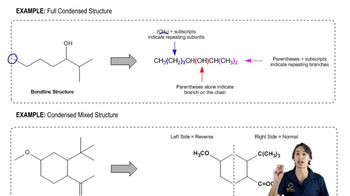
A condensed structural formula is a way of representing a chemical compound that shows the arrangement of atoms and the connectivity between them without depicting all the bonds explicitly. It typically groups atoms together to indicate how they are connected, making it easier to visualize the structure of organic molecules. For example, in a condensed formula, CH3-CH2-CH=CH2 represents butene without showing every bond.
추천 영상:
06:06
How to interpret condensed structures.

Geometric Isomerism

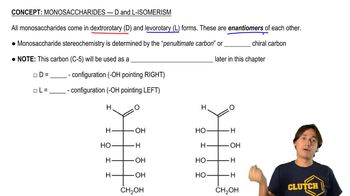
Geometric isomerism occurs in compounds with restricted rotation around a double bond, leading to different spatial arrangements of substituents. The terms 'Z' (from the German 'zusammen', meaning together) and 'E' (from 'entgegen', meaning opposite) are used to describe the relative positions of the highest priority substituents on either side of the double bond. Understanding this concept is crucial for accurately drawing the structures of compounds like (Z)-1,3,5-tribromo-2-pentene.
추천 영상:
06:47
Monosaccharides - D and L Isomerism

Numbering and Naming Alkenes

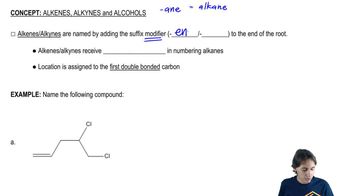
The IUPAC naming system for alkenes involves numbering the carbon chain to give the double bond the lowest possible number, while also considering substituents. The position of the double bond and the substituents must be indicated in the name, which helps in constructing the correct condensed structure. For instance, in (E)-1,2-dibromo-3-isopropyl-2-hexene, the numbering reflects the position of the double bond and the substituents on the hexene chain.
추천 영상:
01:55
How to name alkenes and alkynes