Ch. 5 - Alkenes: Structure, Nomenclature, and an Introduction to Reactivity • Thermodynamics and Kinetics
Bruice - Organic Chemistry 8th Edition
Bruice8th EditionOrganic ChemistryISBN: 9780135213711당신이 사용하는 게 아니라요?교과서 변경
5장, 문제 31b

The rate of the reaction of methyl chloride with hydroxide ion is linearly dependent on both the concentration of methyl chloride and the concentration hydroxide ion. At 30 °C, the constant (k) for the reaction is 1.0 × 10⁻⁵ M-1 s-1
b. If the concentration of methyl chloride is decreased to 0.010 M, what will be the effect on
1. the rate of the reaction?
2. the rate constant for the reaction?

검증된 단계별 안내
1
Step 1: Recognize that the reaction follows second-order kinetics because the rate is linearly dependent on both the concentration of methyl chloride ([CH3Cl]) and hydroxide ion ([OH⁻]). The rate law can be expressed as: r=k⋅[CH3Cl]⋅[OH−.
Step 2: Understand that the rate constant (k) is a property of the reaction and depends only on temperature. Since the temperature (30 °C) is constant, the rate constant (k = 1.0 × 10⁻⁵ M⁻¹ s⁻¹) will remain unchanged regardless of the change in concentration of methyl chloride.
Step 3: To determine the effect on the rate of the reaction, note that the rate is directly proportional to the concentration of methyl chloride. If the concentration of methyl chloride is decreased to 0.010 M, substitute this value into the rate law equation to observe the proportional change in the rate.
Step 4: Compare the new rate to the original rate. If the original concentration of methyl chloride was higher, say [CH3Cl]₀, the new rate will be reduced proportionally by the ratio of the new concentration (0.010 M) to the original concentration ([CH3Cl]₀). This demonstrates that the rate decreases as the concentration of methyl chloride decreases.
Step 5: Summarize the effects: (1) The rate of the reaction will decrease proportionally to the decrease in the concentration of methyl chloride. (2) The rate constant (k) will remain unchanged because it is independent of reactant concentrations and depends only on temperature.

비슷한 문제에 대한 검증된 영상 답변:

이 영상 해법은 위 문제에 도움이 된다고 튜터들이 추천한 것입니다.
영상 길이:
5m

주요 개념

질문에 올바르게 답하기 위해 반드시 이해해야 하는 핵심 개념들은 다음과 같습니다.

Rate of Reaction

The rate of a chemical reaction refers to the speed at which reactants are converted into products. It is typically expressed in terms of the change in concentration of a reactant or product over time. In this case, the rate is directly proportional to the concentrations of both methyl chloride and hydroxide ion, indicating a second-order reaction.
추천 영상:
가이드 코스
5:07
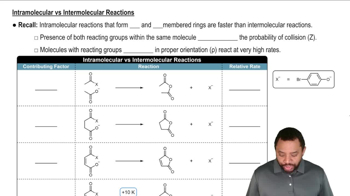
Rates of Intramolecular Reactions Concept 2

Rate Constant (k)

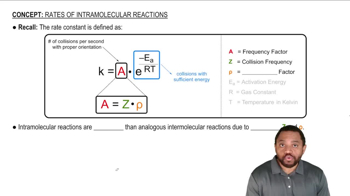
The rate constant (k) is a proportionality factor that relates the rate of a reaction to the concentrations of the reactants. It is specific to a given reaction at a particular temperature. In this scenario, the rate constant remains unchanged regardless of the concentrations of the reactants, as it is a characteristic of the reaction itself at 30 °C.
추천 영상:
가이드 코스
2:29
Rates of Intramolecular Reactions Concept 1

Concentration Effects on Reaction Rate

In a reaction where the rate is dependent on the concentrations of reactants, changing the concentration of one reactant will affect the overall rate. If the concentration of methyl chloride is decreased, the rate of the reaction will also decrease proportionally, while the rate constant (k) will remain constant, as it is independent of reactant concentrations.
추천 영상:
가이드 코스
5:07
Rates of Intramolecular Reactions Concept 2