Ch. 6 - The Reactions of Alkenes • The Stereochemistry of Addition Reactions
Bruice - Organic Chemistry 8th Edition
Bruice8th EditionOrganic ChemistryISBN: 9780135213711당신이 사용하는 게 아니라요?교과서 변경
6장, 문제 82c

Draw the products of the following reactions. If the products can exist as stereoisomers, show which stereoisomers are formed
c. 1-ethylcyclohexene + H2O + H2SO4

검증된 단계별 안내
1
Step 1: Recognize the reaction type. This is an acid-catalyzed hydration reaction where H2SO4 acts as the catalyst and H2O provides the nucleophile. The reaction follows Markovnikov's rule, meaning the OH group will add to the more substituted carbon of the double bond.
Step 2: Protonation of the alkene. The double bond in 1-ethylcyclohexene will react with H⁺ (from H2SO4), forming a carbocation intermediate. The proton will add to the less substituted carbon of the double bond, resulting in a carbocation at the more substituted carbon.
Step 3: Consider carbocation stability. The carbocation formed at the more substituted carbon is stable due to hyperconjugation and inductive effects. No rearrangement is expected in this case.
Step 4: Nucleophilic attack by water. The lone pair of electrons on the oxygen atom in H2O will attack the carbocation, forming an oxonium ion intermediate.
Step 5: Deprotonation of the oxonium ion. A base (likely HSO4⁻) will remove a proton from the oxonium ion, resulting in the formation of the alcohol product. The product will be 1-ethylcyclohexanol, and since the addition of water is not stereospecific, both stereoisomers (R and S configurations) of the alcohol can be formed.

비슷한 문제에 대한 검증된 영상 답변:

이 영상 해법은 위 문제에 도움이 된다고 튜터들이 추천한 것입니다.
영상 길이:
3m

주요 개념

질문에 올바르게 답하기 위해 반드시 이해해야 하는 핵심 개념들은 다음과 같습니다.

Electrophilic Addition

Electrophilic addition is a fundamental reaction mechanism in organic chemistry where an electrophile reacts with a nucleophile, leading to the formation of a new bond. In this case, the double bond in 1-ethylcyclohexene acts as a nucleophile, attacking the electrophile, which is the proton from sulfuric acid (H2SO4). This reaction typically results in the formation of carbocations, which are key intermediates in the process.
추천 영상:
09:23
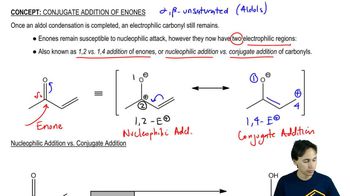
1,2 vs 1,4 Addition

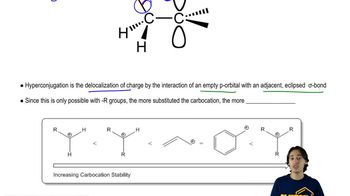
Carbocation Stability

Carbocation stability is crucial in determining the outcome of electrophilic addition reactions. Carbocations are positively charged species that can vary in stability based on their structure; tertiary carbocations are more stable than secondary or primary ones due to hyperconjugation and inductive effects. In the reaction of 1-ethylcyclohexene, the formation of a more stable carbocation will influence the regioselectivity of the addition of water.
추천 영상:
05:58
Determining Carbocation Stability

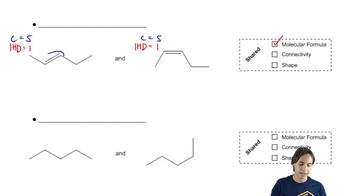
Stereoisomerism

Stereoisomerism refers to the phenomenon where compounds have the same molecular formula and connectivity but differ in the spatial arrangement of atoms. In the context of the reaction, the addition of water to the carbocation can lead to the formation of stereoisomers, particularly if the carbocation is chiral. Understanding how to depict and differentiate these stereoisomers is essential for accurately representing the products of the reaction.
추천 영상:
01:58
Determining when molecules are stereoisomers.