Ch. 6 - The Reactions of Alkenes • The Stereochemistry of Addition Reactions
Bruice - Organic Chemistry 8th Edition
Bruice8th EditionOrganic ChemistryISBN: 9780135213711당신이 사용하는 게 아니라요?교과서 변경
6장, 문제 14c

How could the following compounds be prepared using an alkene as one of the starting materials?
c.

검증된 단계별 안내
1
Step 1: Identify the target compound. The given compound is 2-butanol (CH₃CH(OH)CH₂CH₃), which contains a hydroxyl (-OH) group attached to the second carbon of a butane chain.
Step 2: Recognize that the preparation involves using an alkene as a starting material. To form 2-butanol, the corresponding alkene would be 2-butene (CH₃CH=CHCH₃). This is because the hydroxyl group is added to the second carbon in the chain.
Step 3: Select the appropriate reaction mechanism. The addition of a hydroxyl group to an alkene can be achieved through hydration reactions. Specifically, acid-catalyzed hydration or oxymercuration-demercuration can be used to add water (H₂O) across the double bond.
Step 4: Explain the regioselectivity. In the case of 2-butene, Markovnikov's rule applies, meaning the hydroxyl group will attach to the more substituted carbon (the second carbon in this case) during the reaction.
Step 5: Describe the reaction conditions. For acid-catalyzed hydration, the alkene is treated with dilute sulfuric acid (H₂SO₄) and water. Alternatively, for oxymercuration-demercuration, the alkene is reacted with mercuric acetate (Hg(OAc)₂) in water, followed by reduction with sodium borohydride (NaBH₄). Both methods yield 2-butanol as the product.

비슷한 문제에 대한 검증된 영상 답변:

이 영상 해법은 위 문제에 도움이 된다고 튜터들이 추천한 것입니다.
영상 길이:
3m

주요 개념

질문에 올바르게 답하기 위해 반드시 이해해야 하는 핵심 개념들은 다음과 같습니다.

Alkene Reactivity

Alkenes are unsaturated hydrocarbons characterized by at least one carbon-carbon double bond. This double bond makes them highly reactive, allowing them to undergo various reactions such as electrophilic addition, polymerization, and oxidation. Understanding the reactivity of alkenes is crucial for predicting the products formed when they are used as starting materials in organic synthesis.
추천 영상:
가이드 코스
2:09
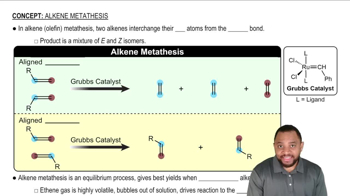
Alkene Metathesis Concept 1

Electrophilic Addition Reactions

Electrophilic addition reactions involve the addition of electrophiles to the double bond of alkenes, resulting in the formation of more saturated compounds. Common electrophiles include halogens, hydrogen halides, and water. Mastery of these reactions is essential for transforming alkenes into desired products, as they dictate the types of functional groups that can be introduced during synthesis.
추천 영상:
05:39
Features of Addition Mechanisms.

Synthesis Strategies

Synthesis strategies in organic chemistry involve planning the steps required to construct a target molecule from simpler starting materials. This includes selecting appropriate reactions, reagents, and conditions to achieve the desired transformations. A solid understanding of synthesis strategies is vital for effectively preparing compounds from alkenes, as it allows chemists to navigate complex reaction pathways and optimize yields.
추천 영상:
가이드 코스
1:16
Synthesis of Amino Acids: Strecker Synthesis Example 1