Ch. 6 - The Reactions of Alkenes • The Stereochemistry of Addition Reactions
Bruice - Organic Chemistry 8th Edition
Bruice8th EditionOrganic ChemistryISBN: 9780135213711당신이 사용하는 게 아니라요?교과서 변경
6장, 문제 91

Two chemists at Dupont found that ICH2ZnI is better than diazomethane at converting a C=C bond to a cylcopropane ring. Propose a mechanism for the reaction, now known as the Simmons–Smith reaction in their honor.

검증된 단계별 안내
1
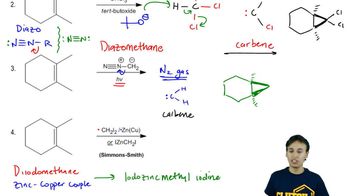
Step 1: Recognize that the Simmons–Smith reaction involves the conversion of an alkene (C=C bond) into a cyclopropane ring using the reagent ICH2ZnI. This reagent acts as a carbenoid, which is a species that mimics the reactivity of a carbene.
Step 2: Understand the role of ICH2ZnI. The reagent is formed by the reaction of diiodomethane (ICH2I) with a zinc-copper couple. The zinc stabilizes the carbenoid intermediate, making it reactive toward the alkene.
Step 3: Propose the mechanism. The carbenoid (ICH2ZnI) approaches the alkene, and the zinc coordinates with the π-electrons of the double bond. This interaction facilitates the transfer of the CH2 group to the alkene.
Step 4: Describe the cyclopropanation step. The CH2 group inserts into the double bond of the alkene, forming a three-membered cyclopropane ring. This occurs via a concerted mechanism, where bonds are broken and formed simultaneously.
Step 5: Highlight the stereochemical implications. The Simmons–Smith reaction typically preserves the stereochemistry of the alkene, meaning that the substituents on the original double bond will determine the stereochemistry of the cyclopropane ring.

비슷한 문제에 대한 검증된 영상 답변:

이 영상 해법은 위 문제에 도움이 된다고 튜터들이 추천한 것입니다.
영상 길이:
4m

주요 개념

질문에 올바르게 답하기 위해 반드시 이해해야 하는 핵심 개념들은 다음과 같습니다.

Simmons-Smith Reaction

The Simmons-Smith reaction is a chemical reaction that converts alkenes into cyclopropanes using a reagent composed of diiodomethane (ICH2I) and zinc. This reaction is notable for its ability to form cyclopropane rings in a stereospecific manner, preserving the configuration of the starting alkene. The reaction proceeds through a carbenoid intermediate, which facilitates the addition of the methylene group across the double bond.
추천 영상:
03:13
The Simmons-Smith reaction.

Carbenoid Intermediates

Carbenoid intermediates are reactive species that resemble carbenes but are stabilized by metal complexes, such as zinc in the Simmons-Smith reaction. These intermediates can participate in various reactions, including cyclopropanation, by inserting into double bonds. The presence of a carbenoid allows for the formation of new carbon-carbon bonds while maintaining the integrity of the original alkene structure.
추천 영상:
04:31
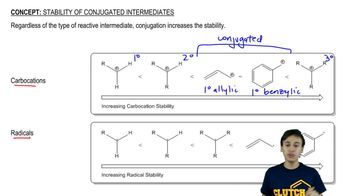
Stability of Conjugated Intermediates

Mechanism of Cyclopropanation

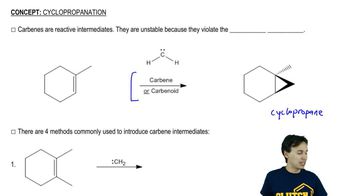
The mechanism of cyclopropanation involves the addition of a carbenoid to an alkene, resulting in the formation of a three-membered cyclopropane ring. Initially, the alkene attacks the carbenoid, leading to a transition state that ultimately collapses to form the cyclopropane. This process is characterized by a concerted mechanism, where bond formation and breaking occur simultaneously, ensuring that the stereochemistry of the alkene is retained in the product.
추천 영상:
01:49
General properties of cyclopropanation.