Ch. 6 - The Reactions of Alkenes • The Stereochemistry of Addition Reactions
Bruice - Organic Chemistry 8th Edition
Bruice8th EditionOrganic ChemistryISBN: 9780135213711당신이 사용하는 게 아니라요?교과서 변경
6장, 문제 66h

What is the major product of each of the following reactions?
h.

검증된 단계별 안내
1
Analyze the structure of the starting compound: The molecule is a substituted cyclohexene with a double bond and two methyl groups attached to the ring. The double bond is the reactive site in this reaction.
Identify the reagent and reaction conditions: Bromine (Br₂) in dichloromethane (CH₂Cl₂) is used. This is a typical halogenation reaction where bromine adds across the double bond in an electrophilic addition mechanism.
Understand the mechanism: Bromine reacts with the double bond to form a bromonium ion intermediate. This intermediate is then attacked by a bromide ion (Br⁻) to yield the dibrominated product.
Determine the stereochemistry: The addition of bromine across the double bond occurs in an anti fashion due to the formation of the bromonium ion. This results in the two bromine atoms being added to opposite faces of the ring.
Predict the major product: The major product will be a vicinal dibromide (two bromine atoms on adjacent carbons) with anti stereochemistry. The positions of the bromine atoms will correspond to the carbons involved in the original double bond.

비슷한 문제에 대한 검증된 영상 답변:

이 영상 해법은 위 문제에 도움이 된다고 튜터들이 추천한 것입니다.
영상 길이:
4m

주요 개념

질문에 올바르게 답하기 위해 반드시 이해해야 하는 핵심 개념들은 다음과 같습니다.

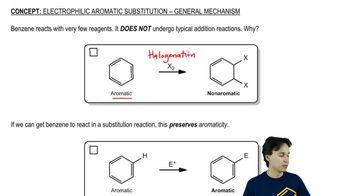
Electrophilic Aromatic Substitution

Electrophilic aromatic substitution (EAS) is a fundamental reaction in organic chemistry where an electrophile replaces a hydrogen atom on an aromatic ring. In this process, the aromatic system retains its stability while introducing new substituents. The reaction typically involves the formation of a sigma complex, followed by deprotonation to restore aromaticity.
추천 영상:
03:07
EAS Review

Bromination of Aromatic Compounds

Bromination is a specific type of electrophilic aromatic substitution where bromine (Br2) acts as the electrophile. In the presence of a non-polar solvent like dichloromethane (CH2Cl2), bromine can add to the aromatic ring, leading to the formation of brominated products. The regioselectivity of the reaction is influenced by the substituents already present on the ring.
추천 영상:
00:54
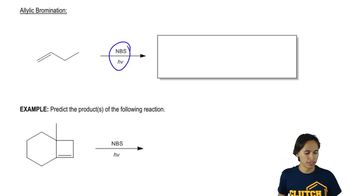
Mechanism of Allylic Bromination.

Regioselectivity in Substitution Reactions

Regioselectivity refers to the preference of a chemical reaction to yield one structural isomer over others when multiple possibilities exist. In the case of bromination of substituted aromatic compounds, the position of the substituents on the ring affects where the bromine will add, typically favoring positions that are ortho or para to existing substituents due to steric and electronic effects.
추천 영상:
01:34
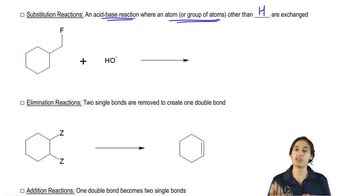
Recognizing Substitution Reactions.