Ch. 6 - The Reactions of Alkenes • The Stereochemistry of Addition Reactions
Bruice - Organic Chemistry 8th Edition
Bruice8th EditionOrganic ChemistryISBN: 9780135213711당신이 사용하는 게 아니라요?교과서 변경
6장, 문제 30e,f

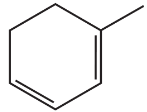
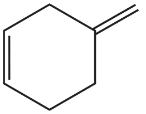
What products are formed when the following compounds react with ozone and then with dimethyl sulfide?
e.
f.

검증된 단계별 안내
1
Step 1: Understand the reaction mechanism. Ozonolysis is a reaction where ozone (O₃) cleaves double bonds in alkenes to form carbonyl compounds. When followed by dimethyl sulfide (DMS), the reaction reduces the intermediate ozonide to aldehydes or ketones.
Step 2: Analyze the first compound (image e). The structure contains a cyclohexene ring with one double bond and a methyl group attached. The double bond will be cleaved by ozone, splitting the molecule into two fragments.
Step 3: Predict the cleavage products for compound e. The double bond in the cyclohexene ring will break, forming two carbonyl groups. The methyl group remains attached to one of the fragments. Use the position of the double bond to determine the exact products.
Step 4: Analyze the second compound (image f). This structure contains a cyclohexene ring with two double bonds, one in the ring and one in the exocyclic position. Both double bonds will undergo cleavage during ozonolysis.
Step 5: Predict the cleavage products for compound f. The cleavage of the double bond in the ring will produce two carbonyl fragments, while the cleavage of the exocyclic double bond will yield additional carbonyl compounds. Consider the positions of the double bonds to determine the exact products.

비슷한 문제에 대한 검증된 영상 답변:

이 영상 해법은 위 문제에 도움이 된다고 튜터들이 추천한 것입니다.
영상 길이:
4m

주요 개념

질문에 올바르게 답하기 위해 반드시 이해해야 하는 핵심 개념들은 다음과 같습니다.

Ozonolysis

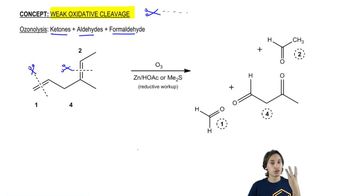
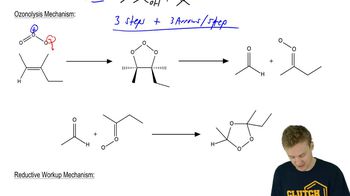
Ozonolysis is a reaction involving the cleavage of alkenes or alkynes using ozone (O3) to form carbonyl compounds, such as aldehydes and ketones. The reaction typically occurs in two steps: first, the alkene reacts with ozone to form a molozonide, which rearranges to form ozonides. These ozonides can then be hydrolyzed or treated with a reducing agent, such as dimethyl sulfide, to yield the final carbonyl products.
추천 영상:
06:30
General properties of ozonolysis.

Dimethyl Sulfide as a Reducing Agent

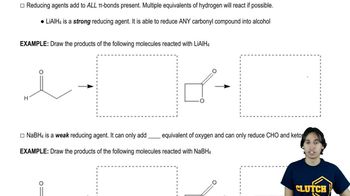
Dimethyl sulfide (DMS) is often used as a reducing agent in organic reactions, particularly in the reduction of ozonides formed during ozonolysis. DMS can effectively convert ozonides into stable carbonyl compounds by reducing them, which helps to prevent the formation of unwanted byproducts. This step is crucial for obtaining the desired aldehydes or ketones from the ozonolysis process.
추천 영상:
09:28
Reducing Agents

Mechanism of Ozone Reaction

The mechanism of the reaction between ozone and alkenes involves the formation of a cyclic intermediate, which is a key step in ozonolysis. This intermediate undergoes rearrangement and cleavage, leading to the formation of carbonyl compounds. Understanding this mechanism is essential for predicting the products of the reaction, as it determines how the original alkene structure is transformed into the final products.
추천 영상:
07:48
General Mechanism: