Ch. 6 - The Reactions of Alkenes • The Stereochemistry of Addition Reactions
Bruice - Organic Chemistry 8th Edition
Bruice8th EditionOrganic ChemistryISBN: 9780135213711당신이 사용하는 게 아니라요?교과서 변경
6장, 문제 20

What will be the product of the preceding reaction if HBr is used in place of Br2?

검증된 단계별 안내
1
Step 1: Identify the type of reaction taking place. When HBr is used, it typically undergoes an electrophilic addition reaction with alkenes or alkynes, or a substitution reaction with alcohols or other functional groups. Determine the functional group present in the starting material.
Step 2: Analyze the mechanism of the reaction. If the starting material contains a double bond (alkene), HBr will add across the double bond following Markovnikov's rule, where the hydrogen atom attaches to the carbon with more hydrogens, and the bromine atom attaches to the carbon with fewer hydrogens.
Step 3: Consider the possibility of carbocation rearrangement. If the intermediate carbocation formed during the reaction can rearrange to a more stable carbocation (e.g., tertiary carbocation), this rearrangement will occur before bromine attaches.
Step 4: Write the structure of the product. After the bromine atom attaches to the appropriate carbon, the final product will be a bromoalkane. Ensure the stereochemistry is considered if applicable.
Step 5: Verify the reaction conditions. Confirm that no other reagents or conditions (e.g., peroxides) are present, as these could alter the mechanism (e.g., anti-Markovnikov addition in the presence of peroxides).

비슷한 문제에 대한 검증된 영상 답변:

이 영상 해법은 위 문제에 도움이 된다고 튜터들이 추천한 것입니다.
영상 길이:
2m

주요 개념

질문에 올바르게 답하기 위해 반드시 이해해야 하는 핵심 개념들은 다음과 같습니다.

Electrophilic Addition

Electrophilic addition is a fundamental reaction mechanism in organic chemistry where an electrophile reacts with a nucleophile, typically involving alkenes or alkynes. In this context, HBr acts as the electrophile, adding across the double bond of an alkene. This process results in the formation of a more stable product, often a bromoalkane, depending on the structure of the starting material.
추천 영상:
09:23
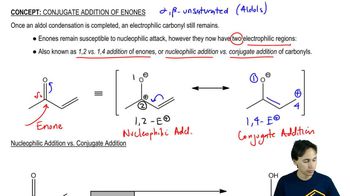
1,2 vs 1,4 Addition

Markovnikov's Rule

Markovnikov's Rule states that when HX (where X is a halogen) adds to an unsymmetrical alkene, the hydrogen atom will attach to the carbon with the greater number of hydrogen atoms already attached. This rule helps predict the major product of the reaction when HBr is used, leading to the formation of the more stable carbocation intermediate and ultimately the more substituted alkyl halide.
추천 영상:
03:54
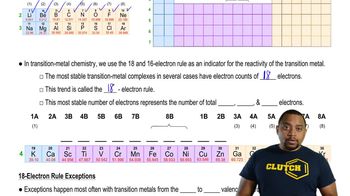
The 18 and 16 Electron Rule

Carbocation Stability

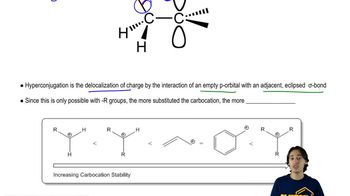
Carbocation stability is a key concept in organic chemistry that refers to the relative stability of positively charged carbon species. Carbocations are stabilized by alkyl groups through hyperconjugation and inductive effects. In the context of the reaction with HBr, the formation of a more stable carbocation intermediate influences the final product, as the reaction pathway will favor the formation of the more substituted and stable carbocation.
추천 영상:
05:58
Determining Carbocation Stability