Ch. 6 - The Reactions of Alkenes • The Stereochemistry of Addition Reactions
Bruice - Organic Chemistry 8th Edition
Bruice8th EditionOrganic ChemistryISBN: 9780135213711당신이 사용하는 게 아니라요?교과서 변경
6장, 문제 46

When Br2 adds to a cis alkene that has different substituents attached to each of the two sp2 carbons, such as cis-2-heptene, identical amounts of the two threo enantiomers are obtained even though Br- is more likely to add to the less sterically hindered carbon of the bromonium ion. Explain why identical amounts of the two enantiomers are obtained.

검증된 단계별 안내
1
The addition of Br₂ to a cis-alkene, such as cis-2-heptene, proceeds via an anti-addition mechanism. This means that the two bromine atoms will add to opposite sides of the double bond plane.
The reaction begins with the formation of a bromonium ion intermediate. When Br₂ approaches the double bond, one bromine atom forms a three-membered cyclic bromonium ion with the two sp² carbons, while the other bromine atom becomes a bromide ion (Br⁻).
The bromonium ion is symmetrical in terms of its geometry, but the substituents on the sp² carbons of the alkene are different. The bromide ion (Br⁻) will attack the more sterically accessible carbon of the bromonium ion, leading to the opening of the three-membered ring.
Because the attack by Br⁻ occurs from the opposite side of the bromonium ion (anti-addition), the stereochemistry of the product is determined by the relative positions of the substituents on the original alkene. For cis-2-heptene, this results in the formation of two threo enantiomers.
The two enantiomers are formed in equal amounts because the bromonium ion intermediate is planar and symmetrical, allowing the bromide ion to attack either carbon with equal probability. This leads to a racemic mixture of the two threo enantiomers.

비슷한 문제에 대한 검증된 영상 답변:

이 영상 해법은 위 문제에 도움이 된다고 튜터들이 추천한 것입니다.
영상 길이:
5m

주요 개념

질문에 올바르게 답하기 위해 반드시 이해해야 하는 핵심 개념들은 다음과 같습니다.

Bromonium Ion Formation

When bromine (Br2) adds to an alkene, it first forms a cyclic bromonium ion intermediate. This occurs when one bromine atom forms a bond with one of the sp2 carbons, creating a three-membered ring. The formation of this ion is crucial because it influences the regioselectivity and stereochemistry of the addition reaction, leading to the formation of different products depending on how the bromonium ion is attacked by the nucleophile.
추천 영상:
가이드 코스
3:39
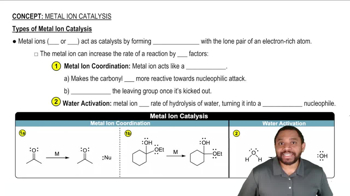
Metal Ion Catalysis Concept 1

Stereochemistry of Alkene Addition

The stereochemistry of alkene addition reactions is determined by the orientation of the reactants and the intermediates formed during the reaction. In the case of cis-2-heptene, the addition of bromine leads to the formation of two threo enantiomers due to the symmetrical nature of the bromonium ion. This symmetry allows for the nucleophile to attack from either side of the bromonium ion, resulting in equal amounts of both enantiomers despite the steric hindrance considerations.
추천 영상:
가이드 코스
1:38
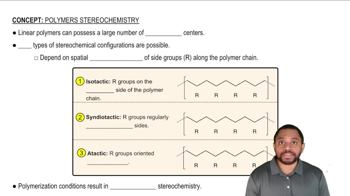
Polymer Stereochemistry Concept 1

Enantiomers and Optical Activity

Enantiomers are pairs of molecules that are non-superimposable mirror images of each other, often differing in their optical activity. In the context of the bromination of cis-2-heptene, the formation of two threo enantiomers means that the reaction produces equal amounts of both forms. This is significant because it highlights how the reaction conditions and the nature of the intermediates can lead to racemic mixtures, where the optical activities of the enantiomers cancel each other out.
추천 영상:
08:17
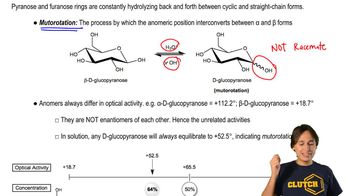
Mutarotation and Optical Activity