Ch. 7 - The Reactions of Alkynes • An Introduction to Multistep Synthesis
Bruice - Organic Chemistry 8th Edition
Bruice8th EditionOrganic ChemistryISBN: 9780135213711당신이 사용하는 게 아니라요?교과서 변경
7장, 문제 50b

Show how the following compounds can be synthesized starting with ethyne:
b. trans-3-heptene

검증된 단계별 안내
1
Step 1: Begin with ethyne (C₂H₂) as the starting material. Ethyne is a simple alkyne with a triple bond between two carbon atoms.
Step 2: Perform a hydroboration-oxidation reaction to convert ethyne into an aldehyde. Use reagents such as disiamylborane (R₂BH) followed by hydrogen peroxide (H₂O₂) and sodium hydroxide (NaOH). This will yield acetaldehyde (CH₃CHO).
Step 3: Perform an aldol condensation reaction. React acetaldehyde with another equivalent of acetaldehyde in the presence of a base (e.g., NaOH) to form crotonaldehyde (CH₃CH=CHCHO), which contains a trans double bond.
Step 4: Extend the carbon chain by performing a Wittig reaction. React crotonaldehyde with a Wittig reagent (e.g., a phosphonium ylide derived from propyl bromide) to form trans-3-heptene. This reaction allows for the selective formation of the trans isomer.
Step 5: Purify the product to isolate trans-3-heptene. Use techniques such as distillation or chromatography to ensure the desired compound is obtained in high purity.

비슷한 문제에 대한 검증된 영상 답변:

이 영상 해법은 위 문제에 도움이 된다고 튜터들이 추천한 것입니다.
영상 길이:
4m

주요 개념

질문에 올바르게 답하기 위해 반드시 이해해야 하는 핵심 개념들은 다음과 같습니다.

Ethyne as a Building Block

Ethyne, also known as acetylene, is a simple alkyne that serves as a versatile building block in organic synthesis. Its triple bond allows for various reactions, including addition reactions with electrophiles, which can lead to the formation of longer carbon chains. Understanding how to manipulate ethyne is crucial for synthesizing more complex molecules like trans-3-heptene.
추천 영상:
16:59
Building a molecular sentence

Alkene Synthesis

Alkenes, such as trans-3-heptene, can be synthesized through various methods, including elimination reactions and hydroboration-oxidation. The formation of alkenes from alkynes typically involves partial hydrogenation or elimination of a dihalide. Recognizing the appropriate reaction pathways is essential for constructing the desired alkene from ethyne.
추천 영상:
가이드 코스
1:47
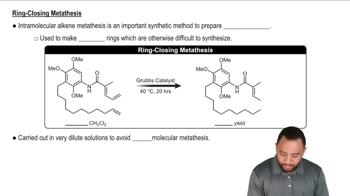
Alkene Metathesis Concept 2

Stereochemistry of Alkenes

Stereochemistry refers to the spatial arrangement of atoms in molecules and is particularly important in alkenes, which can exhibit geometric isomerism. trans-3-heptene has a specific configuration where substituents are on opposite sides of the double bond. Understanding stereochemistry is vital for ensuring the correct isomer is synthesized, as different isomers can have distinct physical and chemical properties.
추천 영상:
가이드 코스
1:38
Polymer Stereochemistry Concept 1