Ch. 7 - The Reactions of Alkynes • An Introduction to Multistep Synthesis
Bruice - Organic Chemistry 8th Edition
Bruice8th EditionOrganic ChemistryISBN: 9780135213711당신이 사용하는 게 아니라요?교과서 변경
7장, 문제 38c

What reagents would you use for the following syntheses?
c. hexane from 3-hexyne

검증된 단계별 안내
1
Step 1: Recognize that the goal is to convert 3-hexyne (an alkyne) into hexane (an alkane). This requires a complete reduction of the triple bond to a single bond.
Step 2: Understand that the reduction of an alkyne to an alkane can be achieved using hydrogen gas (H₂) in the presence of a metal catalyst, such as palladium (Pd) or platinum (Pt). This process is known as catalytic hydrogenation.
Step 3: Note that the reaction typically proceeds in two stages: first, the alkyne is reduced to an alkene, and then the alkene is further reduced to an alkane. Using excess hydrogen gas ensures the reaction goes all the way to the alkane stage.
Step 4: Write the chemical equation for the reaction: C6H10+4H2→C6H14. This shows the addition of hydrogen molecules to the alkyne to form hexane.
Step 5: Summarize the reagents needed: Use hydrogen gas (H₂) and a metal catalyst such as palladium (Pd) or platinum (Pt) under appropriate conditions (e.g., room temperature and pressure or slightly elevated conditions).

비슷한 문제에 대한 검증된 영상 답변:

이 영상 해법은 위 문제에 도움이 된다고 튜터들이 추천한 것입니다.
영상 길이:
2m

주요 개념

질문에 올바르게 답하기 위해 반드시 이해해야 하는 핵심 개념들은 다음과 같습니다.

Alkyne Reduction

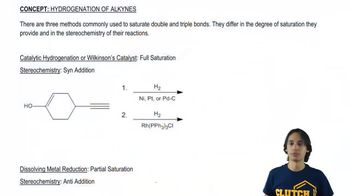
Alkynes can be reduced to alkanes through various methods, typically involving hydrogenation. In this process, the triple bond of the alkyne is converted into a single bond, resulting in the formation of an alkane. Common reagents for this transformation include hydrogen gas (H2) in the presence of a catalyst such as palladium, platinum, or nickel.
추천 영상:
04:40
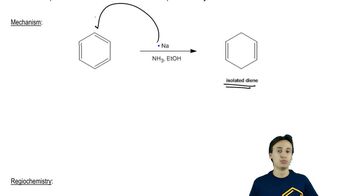
Birch Reduction Mechanism

Reagents for Synthesis

Choosing the correct reagents is crucial for successful organic synthesis. In the case of synthesizing hexane from 3-hexyne, one would typically use hydrogenation reagents. Understanding the reactivity and selectivity of these reagents helps in determining the most efficient pathway for the desired product.
추천 영상:
가이드 코스
1:16
Synthesis of Amino Acids: Strecker Synthesis Example 1

Mechanism of Hydrogenation

The mechanism of hydrogenation involves the adsorption of the alkyne onto the surface of the metal catalyst, followed by the addition of hydrogen atoms across the triple bond. This process is stereospecific and can lead to the formation of different isomers depending on the conditions used. Familiarity with this mechanism is essential for predicting the outcome of the reaction.
추천 영상:
00:48
The definition of hydrogenation.