Ch. 8 - Delocalized Electrons: Their Effect on Stability, pKa, and the Products of a Reaction • Aromaticity and Electronic Effects: An Introduction to the Reactions of Benzene
Bruice - Organic Chemistry 8th Edition
Bruice8th EditionOrganic ChemistryISBN: 9780135213711당신이 사용하는 게 아니라요?교과서 변경
8장, 문제 86c

Answer the following questions for the molecular orbitals (MOs) of 1,3,5,7-octatetraene:
c. Which MOs are symmetric, and which are antisymmetric?

검증된 단계별 안내
1
Understand the molecular structure of 1,3,5,7-octatetraene: It is a conjugated system with 8 π-electrons distributed across 8 p-orbitals. These p-orbitals combine to form 8 molecular orbitals (MOs), which are either bonding, non-bonding, or anti-bonding.
Recall the symmetry properties of molecular orbitals: Symmetric MOs remain unchanged when reflected across a plane of symmetry (e.g., the molecular plane or a vertical plane passing through the molecule), while antisymmetric MOs change sign under such reflections.
Construct the molecular orbital diagram for 1,3,5,7-octatetraene: The MOs are formed by the linear combination of the 8 p-orbitals. Label the MOs as Ψ₁, Ψ₂, Ψ₃, ..., Ψ₈, where Ψ₁ is the lowest-energy bonding orbital and Ψ₈ is the highest-energy anti-bonding orbital.
Analyze the symmetry of each MO: Use the nodal patterns of the MOs to determine their symmetry. For example, Ψ₁ (the lowest-energy MO) has no nodes and is symmetric, while Ψ₂ (the next MO) has one node and is antisymmetric. Continue this analysis for all 8 MOs.
Summarize the results: Identify which MOs are symmetric and which are antisymmetric based on their nodal patterns and behavior under symmetry operations. Typically, bonding MOs with even numbers of nodes are symmetric, while those with odd numbers of nodes are antisymmetric.

비슷한 문제에 대한 검증된 영상 답변:

이 영상 해법은 위 문제에 도움이 된다고 튜터들이 추천한 것입니다.
영상 길이:
8m

주요 개념

질문에 올바르게 답하기 위해 반드시 이해해야 하는 핵심 개념들은 다음과 같습니다.

Molecular Orbitals (MOs)

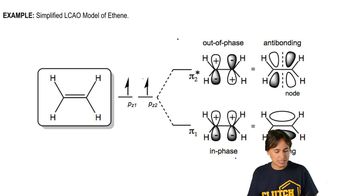
Molecular orbitals are formed by the linear combination of atomic orbitals (LCAO) when atoms bond together. They can be classified as bonding, antibonding, or non-bonding, depending on their energy levels and stability. In conjugated systems like 1,3,5,7-octatetraene, MOs play a crucial role in determining the molecule's electronic properties and reactivity.
추천 영상:
08:41
Review of Molecular Orbitals

Symmetry in Molecular Orbitals

Symmetry in molecular orbitals refers to how the wave functions of the orbitals behave under symmetry operations, such as rotation or reflection. Symmetric orbitals remain unchanged under these operations, while antisymmetric orbitals change sign. Understanding the symmetry of MOs is essential for predicting their behavior in chemical reactions and interactions.
추천 영상:
08:41
Review of Molecular Orbitals

Conjugation and its Effects

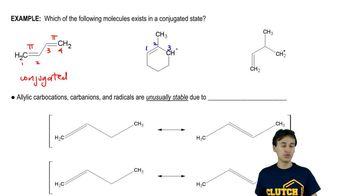
Conjugation occurs when alternating single and double bonds allow for the delocalization of π electrons across multiple adjacent atoms. This delocalization stabilizes the molecule and affects the energy levels of the MOs. In 1,3,5,7-octatetraene, the conjugated system leads to a specific arrangement of symmetric and antisymmetric MOs, influencing the molecule's optical and electronic properties.
추천 영상:
03:27
Conjugated states