Ch. 8 - Delocalized Electrons: Their Effect on Stability, pKa, and the Products of a Reaction • Aromaticity and Electronic Effects: An Introduction to the Reactions of Benzene
Bruice - Organic Chemistry 8th Edition
Bruice8th EditionOrganic ChemistryISBN: 9780135213711당신이 사용하는 게 아니라요?교과서 변경
8장, 문제 99b

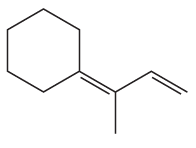
Draw the major products obtained from the reaction of one equivalent of HBr with the following compounds. For each reaction, indicate the kinetic product and the thermodynamic product.
b. Chemical structure illustrating the reaction of HBr with a conjugated system, showing major products and their classifications.

검증된 단계별 안내
1
Analyze the structure of the given compound. The molecule contains two double bonds: one in the cyclopentene ring and one in the side chain. These are sites for electrophilic addition reactions with HBr.
Understand the mechanism of the reaction. HBr adds to alkenes via an electrophilic addition mechanism. The proton (H⁺) from HBr will first attack the double bond, forming a carbocation intermediate. The Br⁻ ion will then attack the carbocation to form the final product.
Determine the kinetic product. The kinetic product is formed faster and typically involves the more stable carbocation intermediate. In this case, protonation of the double bond in the side chain will lead to a secondary carbocation, which is more stable than the primary carbocation formed by protonation of the cyclopentene double bond.
Determine the thermodynamic product. The thermodynamic product is more stable overall and typically involves the addition of HBr to the more substituted double bond. In this case, the double bond in the cyclopentene ring is more substituted, so protonation here will lead to the thermodynamic product.
Draw the major products. For the kinetic product, HBr adds to the side chain double bond, resulting in a bromine atom attached to the carbon adjacent to the cyclopentene ring. For the thermodynamic product, HBr adds to the cyclopentene double bond, resulting in a bromine atom attached to the more substituted carbon in the ring.

비슷한 문제에 대한 검증된 영상 답변:

이 영상 해법은 위 문제에 도움이 된다고 튜터들이 추천한 것입니다.
영상 길이:
7m

주요 개념

질문에 올바르게 답하기 위해 반드시 이해해야 하는 핵심 개념들은 다음과 같습니다.

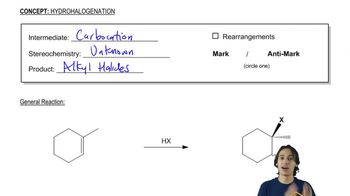
Hydrohalogenation

Hydrohalogenation is a chemical reaction where an alkene reacts with a hydrogen halide (like HBr) to form an alkyl halide. The reaction typically follows Markovnikov's rule, where the hydrogen atom from the hydrogen halide adds to the carbon with the most hydrogen substituents, leading to the formation of a more stable carbocation intermediate.
추천 영상:
04:07
General properties of hydrohalogenation.

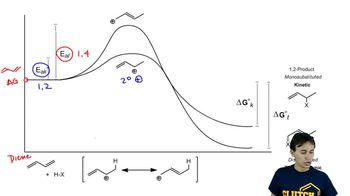
Kinetic vs. Thermodynamic Products

In organic reactions, kinetic products are formed faster and are typically less stable, while thermodynamic products are more stable and form more slowly. Kinetic control occurs at lower temperatures or shorter reaction times, favoring the product that forms more quickly. In contrast, thermodynamic control occurs at higher temperatures, allowing the system to reach a more stable state.
추천 영상:
08:51
Kinetic vs. Thermodynamic Control

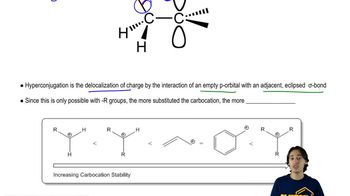
Carbocation Stability

Carbocation stability is a key factor in determining the outcome of reactions involving alkenes. Carbocations are positively charged carbon species, and their stability increases with the degree of substitution: tertiary carbocations are more stable than secondary, which are more stable than primary. The stability influences which product is formed during hydrohalogenation, affecting both kinetic and thermodynamic outcomes.
추천 영상:
05:58
Determining Carbocation Stability