Ch. 8 - Delocalized Electrons: Their Effect on Stability, pKa, and the Products of a Reaction • Aromaticity and Electronic Effects: An Introduction to the Reactions of Benzene
Bruice - Organic Chemistry 8th Edition
Bruice8th EditionOrganic ChemistryISBN: 9780135213711당신이 사용하는 게 아니라요?교과서 변경
8장, 문제 46a

Explain why the following compounds are not optically active:
a. the product obtained from the reaction of 1,3-butadiene with cis-1,2-dichloroethene

검증된 단계별 안내
1
Identify the type of reaction occurring between 1,3-butadiene and cis-1,2-dichloroethene. This is a Diels-Alder reaction, which is a [4+2] cycloaddition reaction where a conjugated diene (1,3-butadiene) reacts with a dienophile (cis-1,2-dichloroethene) to form a cyclic product.
Analyze the stereochemistry of the reactants. Cis-1,2-dichloroethene has a plane of symmetry due to the cis arrangement of the chlorine atoms, making it achiral. 1,3-butadiene is also achiral because it is a planar molecule with no stereogenic centers.
Determine the stereochemistry of the product. The Diels-Alder reaction is stereospecific, meaning the stereochemistry of the dienophile (cis-1,2-dichloroethene) is preserved in the product. The product will have the substituents (chlorine atoms) on the same side of the newly formed six-membered ring, resulting in a meso compound.
Explain why the product is not optically active. A meso compound has an internal plane of symmetry, which makes it achiral even though it contains stereogenic centers. The presence of this symmetry prevents the compound from rotating plane-polarized light, rendering it optically inactive.
Conclude that the lack of optical activity in the product is due to the formation of a meso compound, which arises from the stereospecific nature of the Diels-Alder reaction and the symmetry of the reactants.

비슷한 문제에 대한 검증된 영상 답변:

이 영상 해법은 위 문제에 도움이 된다고 튜터들이 추천한 것입니다.
영상 길이:
5m

주요 개념

질문에 올바르게 답하기 위해 반드시 이해해야 하는 핵심 개념들은 다음과 같습니다.

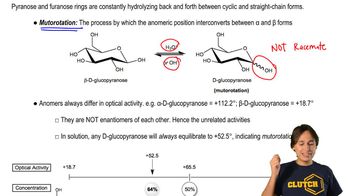
Optical Activity

Optical activity refers to the ability of a chiral compound to rotate the plane of polarized light. A compound is considered optically active if it lacks an internal plane of symmetry and has a non-superimposable mirror image. This property is crucial for distinguishing between enantiomers, which are pairs of chiral molecules that are mirror images of each other.
추천 영상:
08:17
Mutarotation and Optical Activity

Chirality and Symmetry

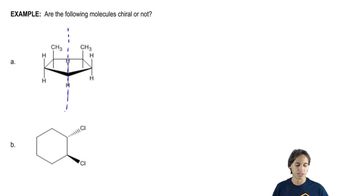
Chirality is a geometric property of some molecules that makes them non-superimposable on their mirror images. A molecule is chiral if it has at least one carbon atom bonded to four different substituents, leading to two distinct enantiomers. Conversely, if a molecule has an internal plane of symmetry, it is achiral and cannot exhibit optical activity.
추천 영상:
00:25
Determining Chirality with Plane of Symmetry

Reaction Products and Stereochemistry

The stereochemistry of reaction products is essential in determining their optical activity. In the case of the reaction between 1,3-butadiene and cis-1,2-dichloroethene, the resulting product may have a symmetrical structure that leads to the cancellation of optical activity. Understanding the spatial arrangement of atoms in the product helps in assessing whether it is chiral or achiral.
추천 영상:
가이드 코스
1:38
Polymer Stereochemistry Concept 1