Ch. 8 - Delocalized Electrons: Their Effect on Stability, pKa, and the Products of a Reaction • Aromaticity and Electronic Effects: An Introduction to the Reactions of Benzene
Bruice - Organic Chemistry 8th Edition
Bruice8th EditionOrganic ChemistryISBN: 9780135213711당신이 사용하는 게 아니라요?교과서 변경
8장, 문제 37b

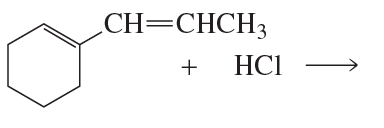
What are the major 1,2- and 1,4-addition products of the following reaction? Indicate the kinetic and the thermodynamic products.
b. Chemical reaction showing the addition of HCl to an alkene, illustrating 1,2- and 1,4-addition products.

검증된 단계별 안내
1
Step 1: Analyze the structure provided in the image. The molecule is a conjugated diene, specifically cyclopentadiene, which has two double bonds in conjugation. This makes it suitable for electrophilic addition reactions.
Step 2: Understand the reaction mechanism. In electrophilic addition reactions to conjugated dienes, the electrophile (e.g., H⁺) adds to one of the double bonds, forming a carbocation intermediate. The carbocation can then undergo resonance to form two different intermediates.
Step 3: Identify the possible products. The 1,2-addition product forms when the electrophile adds to one double bond and the nucleophile adds to the adjacent carbon. The 1,4-addition product forms when the electrophile adds to one double bond and the nucleophile adds to the carbon at the other end of the conjugated system.
Step 4: Distinguish between kinetic and thermodynamic control. The kinetic product is formed faster and typically involves the more stable carbocation intermediate. The thermodynamic product is more stable overall and forms under conditions that allow the reaction to reach equilibrium.
Step 5: Predict the major products. The 1,2-addition product is usually the kinetic product because it forms faster due to proximity of the nucleophile to the carbocation. The 1,4-addition product is typically the thermodynamic product because it results in a more substituted and stable double bond.

비슷한 문제에 대한 검증된 영상 답변:

이 영상 해법은 위 문제에 도움이 된다고 튜터들이 추천한 것입니다.
영상 길이:
7m

주요 개념

질문에 올바르게 답하기 위해 반드시 이해해야 하는 핵심 개념들은 다음과 같습니다.

1,2- and 1,4-Addition Reactions

1,2- and 1,4-addition reactions refer to the ways in which reagents can add to conjugated systems, such as alkenes. In 1,2-addition, the reagent adds to the first and second carbon atoms of the double bond, while in 1,4-addition, it adds to the first and fourth carbon atoms. These pathways lead to different products, which can have distinct stability and reactivity.
추천 영상:
가이드 코스
1:42
Addition Reactions of Furan Concept 1

Kinetic vs. Thermodynamic Products

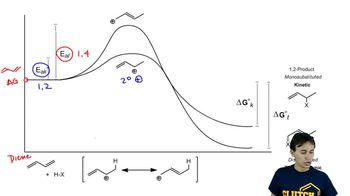
Kinetic and thermodynamic products arise from different reaction conditions and pathways. Kinetic products are formed faster and are typically less stable, while thermodynamic products are more stable and form more slowly. Understanding the conditions that favor one over the other, such as temperature and reaction time, is crucial for predicting the outcome of addition reactions.
추천 영상:
08:51
Kinetic vs. Thermodynamic Control

Conjugated Systems

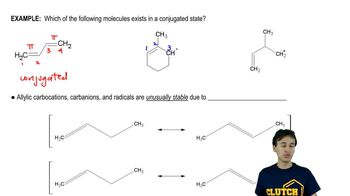
Conjugated systems consist of alternating single and double bonds, allowing for delocalization of electrons. This delocalization stabilizes the molecule and influences its reactivity. In the context of addition reactions, the presence of conjugation can affect the regioselectivity and the stability of the resulting products, making it essential to consider when analyzing reaction outcomes.
추천 영상:
03:27
Conjugated states