Ch. 8 - Delocalized Electrons: Their Effect on Stability, pKa, and the Products of a Reaction • Aromaticity and Electronic Effects: An Introduction to the Reactions of Benzene
Bruice - Organic Chemistry 8th Edition
Bruice8th EditionOrganic ChemistryISBN: 9780135213711당신이 사용하는 게 아니라요?교과서 변경
8장, 문제 32a

What are the products of the following reactions, assuming that one equivalent of each reagent is used in each reaction? Disregard stereoisomers.
a.

검증된 단계별 안내
1
Step 1: Analyze the structure of the starting compound. The molecule contains two conjugated double bonds (CH3CH=CH-CH=CHCH3). This is a diene system, and the reaction involves chlorine (Cl2), which is an electrophile.
Step 2: Understand the reaction mechanism. Chlorine reacts with alkenes via an electrophilic addition mechanism. In the case of conjugated dienes, the reaction can proceed through either 1,2-addition or 1,4-addition, depending on the stability of the intermediate carbocation.
Step 3: Determine the most likely site of reaction. The double bonds in the conjugated diene are electron-rich and will attract the electrophilic chlorine molecule. The reaction will likely occur at one of the double bonds, forming a chloronium ion intermediate.
Step 4: Predict the product formation. After the chloronium ion intermediate is formed, a chloride ion (Cl⁻) will attack the carbocation, leading to the addition of chlorine atoms across the double bond. Since one equivalent of Cl2 is used, only one double bond will react.
Step 5: Write the final product structure. The product will have one double bond remaining, and two chlorine atoms will be added to the carbon atoms of the reacted double bond. Disregard stereoisomers as instructed.

비슷한 문제에 대한 검증된 영상 답변:

이 영상 해법은 위 문제에 도움이 된다고 튜터들이 추천한 것입니다.
영상 길이:
5m

주요 개념

질문에 올바르게 답하기 위해 반드시 이해해야 하는 핵심 개념들은 다음과 같습니다.

Reaction Mechanisms

Understanding reaction mechanisms is crucial in organic chemistry as they describe the step-by-step process by which reactants transform into products. This includes identifying intermediates, transition states, and the movement of electrons. Familiarity with common mechanisms, such as nucleophilic substitution and elimination, helps predict the outcome of reactions.
추천 영상:
02:16
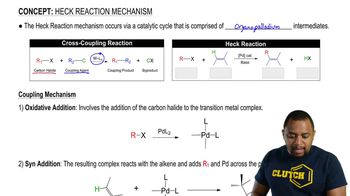
Heck Reaction Mechanism

Functional Groups

Functional groups are specific groups of atoms within molecules that are responsible for the characteristic chemical reactions of those molecules. Recognizing functional groups allows chemists to predict reactivity and the types of products formed in reactions. For example, alcohols, carboxylic acids, and amines each have distinct reactivity patterns.
추천 영상:
02:36
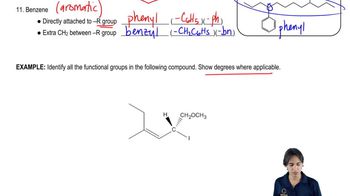
Identifying Functional Groups

Stoichiometry

Stoichiometry involves the calculation of reactants and products in chemical reactions based on the conservation of mass. It is essential for determining the amounts of substances consumed and produced in a reaction. In the context of the question, understanding stoichiometry helps in predicting the products when one equivalent of each reagent is used.
추천 영상:
02:08
Organic molecules in your everyday life.