Ch. 8 - Delocalized Electrons: Their Effect on Stability, pKa, and the Products of a Reaction • Aromaticity and Electronic Effects: An Introduction to the Reactions of Benzene
Bruice - Organic Chemistry 8th Edition
Bruice8th EditionOrganic ChemistryISBN: 9780135213711당신이 사용하는 게 아니라요?교과서 변경
8장, 문제 56

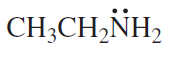
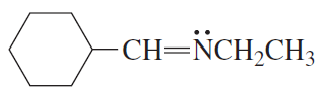
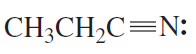
What orbital do the lone-pair electrons occupy in each of the following compounds?
a.
b. Chemical structure showing a hexagonal ring with a double bond to a CH group connected to an N and CH2CH3 group.
c. Chemical structure of a compound with a triple bond and a lone pair of electrons on nitrogen, labeled CH3CH2C≡N:.

검증된 단계별 안내
1
Step 1: Analyze the structure in (i). The compound is CH3CH2CH2NH2, which contains a nitrogen atom with a lone pair of electrons. Nitrogen is sp3 hybridized in this case because it is bonded to three atoms (two hydrogens and one carbon) and has one lone pair. The lone pair occupies an sp3 orbital.
Step 2: Examine the structure in (ii). The compound contains a nitrogen atom bonded to a carbon atom via a double bond (C=N) and a single bond to another carbon atom. Nitrogen in this case is sp2 hybridized because it is bonded to two atoms and has one lone pair. The lone pair occupies an sp2 orbital.
Step 3: Analyze the structure in (iii). The compound contains a nitrogen atom triple-bonded to a carbon atom (C≡N). Nitrogen in this case is sp hybridized because it is bonded to one atom and has one lone pair. The lone pair occupies an sp orbital.
Step 4: Understand the hybridization concept. Hybridization is determined by the number of regions of electron density around the atom. Lone pairs count as one region of electron density, and bonds (single, double, or triple) also count as regions.
Step 5: Summarize the orbital occupancy for the lone pairs: (i) sp3 orbital for CH3CH2CH2NH2, (ii) sp2 orbital for the imine group, and (iii) sp orbital for the nitrile group.

비슷한 문제에 대한 검증된 영상 답변:

이 영상 해법은 위 문제에 도움이 된다고 튜터들이 추천한 것입니다.
영상 길이:
4m

주요 개념

질문에 올바르게 답하기 위해 반드시 이해해야 하는 핵심 개념들은 다음과 같습니다.

Lone Pair Electrons

Lone pair electrons are pairs of valence electrons that are not involved in bonding and are localized on a single atom. They play a crucial role in determining the geometry and reactivity of molecules. Understanding where these electrons reside helps predict molecular shape and polarity, which are essential for analyzing chemical behavior.
추천 영상:
02:33
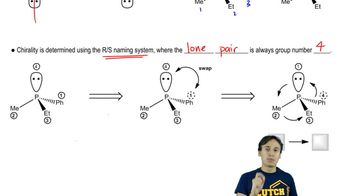
Determining R and S with Lone Pairs

Hybridization

Hybridization is the concept of mixing atomic orbitals to form new hybrid orbitals that can accommodate bonding and lone pair electrons. The type of hybridization (sp, sp2, sp3) influences the geometry of the molecule. For example, sp hybridization leads to linear geometry, while sp3 results in tetrahedral geometry, affecting how lone pairs are positioned.
추천 영상:
10:43
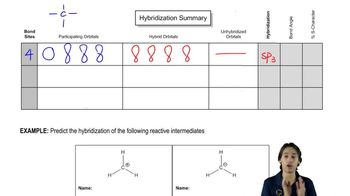
Using bond sites to predict hybridization

Orbital Theory

Orbital theory describes the behavior of electrons in atoms and molecules, focusing on the shapes and energies of orbitals. Each type of orbital (s, p, d, f) has a distinct shape and energy level, influencing how electrons are distributed in a molecule. Understanding orbital theory is essential for determining the location of lone pairs and predicting molecular interactions.
추천 영상:
16:
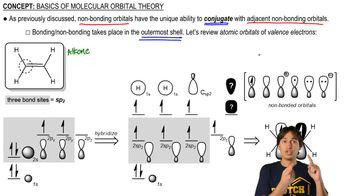
Review of Atomic Orbitals