Explain why the pKa of p-nitrophenol is 7.14, whereas the pKa of m-nitrophenol is 8.39.
Ch. 8 - Delocalized Electrons: Their Effect on Stability, pKa, and the Products of a Reaction • Aromaticity and Electronic Effects: An Introduction to the Reactions of Benzene
모든 교과서
Bruice 8th Edition
Ch. 8 - Delocalized Electrons: Their Effect on Stability, pKa, and the Products of a Reaction • Aromaticity and Electronic Effects: An Introduction to the Reactions of Benzene
문제 21c,d
Bruice 8th Edition
Ch. 8 - Delocalized Electrons: Their Effect on Stability, pKa, and the Products of a Reaction • Aromaticity and Electronic Effects: An Introduction to the Reactions of Benzene
문제 21c,d8장, 문제 21c,d
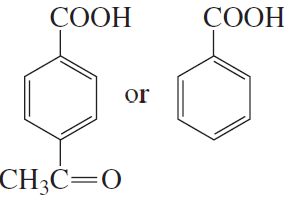
Which acid in each of the following pairs is stronger?
c. 
d. 
검증된 단계별 안내1
Step 1: Analyze the molecular structures in pair (c). The first molecule (i) is cyclohexanecarboxylic acid, while the second molecule (ii) is cyclohexanecarboxylic acid with a ketone group attached to the ring. The ketone group is an electron-withdrawing group.
Step 2: Understand the effect of electron-withdrawing groups on acidity. Electron-withdrawing groups stabilize the conjugate base by delocalizing the negative charge, making the acid stronger.
Step 3: Compare the two molecules in pair (c). The ketone group in molecule (ii) increases the acidity of the carboxylic acid group compared to molecule (i), which lacks the electron-withdrawing ketone group.
Step 4: Analyze the molecular structures in pair (d). The first molecule (i) is cyclopentanecarboxylic acid, while the second molecule (ii) is cyclopentanecarboxylic acid with an amine group (-NH) attached to the ring. The amine group is an electron-donating group.
Step 5: Understand the effect of electron-donating groups on acidity. Electron-donating groups destabilize the conjugate base by increasing electron density, making the acid weaker. Therefore, molecule (i) is stronger than molecule (ii) in pair (d).

비슷한 문제에 대한 검증된 영상 답변:
이 영상 해법은 위 문제에 도움이 된다고 튜터들이 추천한 것입니다.
영상 길이:
6m주요 개념
질문에 올바르게 답하기 위해 반드시 이해해야 하는 핵심 개념들은 다음과 같습니다.
Acidity and pKa
Acidity refers to the ability of a compound to donate a proton (H+) in solution. The strength of an acid is often measured by its pKa value; lower pKa values indicate stronger acids. Understanding the relationship between structure and acidity is crucial, as factors like electronegativity and resonance can significantly influence a compound's ability to stabilize the negative charge of its conjugate base.
추천 영상:
Identifying pKa values
Resonance Stabilization
Resonance stabilization occurs when a molecule can be represented by multiple valid Lewis structures, allowing for the delocalization of electrons. This delocalization can stabilize the conjugate base formed after deprotonation, making the original acid stronger. In the context of the question, comparing the resonance effects in the given acid structures will help determine which acid is stronger.
추천 영상:
The radical stability trend.
Inductive Effect
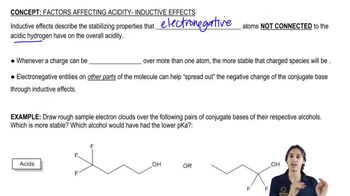
The inductive effect refers to the electron-withdrawing or electron-donating effects transmitted through sigma bonds in a molecule. Electronegative atoms or groups can stabilize the negative charge of a conjugate base through the inductive effect, enhancing acidity. Analyzing the presence of such groups in the acid structures presented will aid in assessing their relative strengths.
추천 영상:
Understanding the Inductive Effect.
관련 실천
교과서 질문
1769
views
교과서 질문
For each of the following substituents, indicate whether it withdraws electrons inductively, donates electrons by hyperconjugation, withdraws electrons by resonance, or donates electrons by resonance.
d. NHCH3
e. OCH3
f. +N(CH3)3
1098
views
교과서 질문
Which acid in each of the following pairs is stronger?
e.
f.
1270
views
교과서 질문
What is the major product obtained from the addition of HBr to the following compound?
1101
views
교과서 질문
Which member of each pair is the stronger base?
c. phenolate ion or ethoxide ion
d. phenolate ion or acetate ion
1490
views
교과서 질문
For each of the following substituents, indicate whether it withdraws electrons inductively, donates electrons by hyperconjugation, withdraws electrons by resonance, or donates electrons by resonance.
a. Br
b. CH2CH3
c.
1287
views