Ch. 8 - Delocalized Electrons: Their Effect on Stability, pKa, and the Products of a Reaction • Aromaticity and Electronic Effects: An Introduction to the Reactions of Benzene
Bruice - Organic Chemistry 8th Edition
Bruice8th EditionOrganic ChemistryISBN: 9780135213711당신이 사용하는 게 아니라요?교과서 변경
8장, 문제 48b

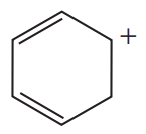
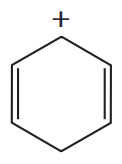
Which of the following are aromatic?
d. Chemical structure of a hexagonal aromatic hydrocarbon with alternating double bonds and a plus sign in the corner.
e. Chemical structure of a hexagonal aromatic hydrocarbon with a positive charge symbol above it.
f. Chemical structure representation of a linear chain of alternating double bonds, labeled with CH2 groups.

검증된 단계별 안내
1
Step 1: Recall the criteria for aromaticity. A molecule is aromatic if it satisfies the following conditions: (1) It is cyclic, (2) It is planar, (3) It has a conjugated π-electron system (alternating single and double bonds), and (4) It follows Huckel's rule, which states that the molecule must have (4n + 2) π-electrons, where n is a non-negative integer.
Step 2: Analyze structure A. Structure A is a cyclic molecule with alternating single and double bonds, indicating conjugation. It has a negative charge, which contributes two π-electrons to the system. Count the total π-electrons in the ring, including those from the double bonds and the negative charge, and check if it satisfies Huckel's rule.
Step 3: Analyze structure B. Structure B is a cyclic molecule with alternating single and double bonds, indicating conjugation. It has a positive charge, which removes one π-electron from the system. Count the total π-electrons in the ring, including those from the double bonds and the positive charge, and check if it satisfies Huckel's rule.
Step 4: Analyze structure C. Structure C is a cyclic molecule with alternating single and double bonds, indicating conjugation. Count the total π-electrons in the ring from the double bonds and check if it satisfies Huckel's rule.
Step 5: Compare the results for structures A, B, and C. Determine which structures satisfy all the criteria for aromaticity, including Huckel's rule, and identify them as aromatic.

비슷한 문제에 대한 검증된 영상 답변:

이 영상 해법은 위 문제에 도움이 된다고 튜터들이 추천한 것입니다.
영상 길이:
5m

주요 개념

질문에 올바르게 답하기 위해 반드시 이해해야 하는 핵심 개념들은 다음과 같습니다.

Aromaticity

Aromaticity is a property of cyclic compounds that exhibit enhanced stability due to the delocalization of π electrons across the ring. For a compound to be aromatic, it must be cyclic, planar, and follow Hückel's rule, which states that it should have 4n + 2 π electrons, where n is a non-negative integer.
추천 영상:
08:19
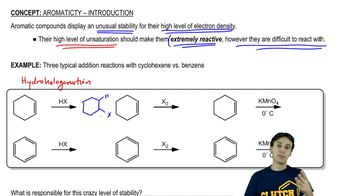
Intro to Aromaticity

Hückel's Rule

Hückel's rule is a criterion used to determine if a planar, cyclic compound is aromatic. According to this rule, a compound is aromatic if it contains a total of 4n + 2 π electrons in its conjugated system, which leads to increased stability and unique chemical properties compared to non-aromatic compounds.
추천 영상:
03:54
The 18 and 16 Electron Rule

Planarity and Conjugation

For a compound to be aromatic, it must be planar, allowing for effective overlap of p orbitals, which facilitates the delocalization of π electrons. Conjugation refers to the alternating single and double bonds that allow for this electron delocalization, contributing to the overall stability and reactivity of the aromatic system.
추천 영상:
03:27
Conjugated states