Ch. 8 - Delocalized Electrons: Their Effect on Stability, pKa, and the Products of a Reaction • Aromaticity and Electronic Effects: An Introduction to the Reactions of Benzene
Bruice - Organic Chemistry 8th Edition
Bruice8th EditionOrganic ChemistryISBN: 9780135213711당신이 사용하는 게 아니라요?교과서 변경
8장, 문제 71c

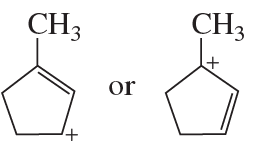
Which resonance contributor in each pair makes the greater contribution to the resonance hybrid?
c. Two resonance structures of a cyclohexane derivative with a methyl group, showing charge distribution differences.

검증된 단계별 안내
1
Identify the resonance contributors in the given pair. Resonance contributors are different Lewis structures that represent the same molecule or ion, differing only in the placement of electrons (not atoms).
Evaluate the stability of each resonance contributor. Stability is influenced by factors such as the octet rule (structures where all atoms satisfy the octet rule are more stable), formal charges (structures with fewer formal charges or charges on more electronegative atoms are more stable), and charge separation (structures with minimal charge separation are preferred).
Compare the resonance contributors based on their stability. The more stable resonance contributor will make a greater contribution to the resonance hybrid because it represents a lower-energy state.
Consider any additional factors, such as aromaticity (if applicable). Aromatic structures are particularly stable and will contribute more to the resonance hybrid. Similarly, avoid structures with highly unstable features, such as positive charges on electronegative atoms like oxygen or nitrogen.
Conclude which resonance contributor in the pair makes the greater contribution to the resonance hybrid based on the analysis of stability and other factors.

비슷한 문제에 대한 검증된 영상 답변:

이 영상 해법은 위 문제에 도움이 된다고 튜터들이 추천한 것입니다.
영상 길이:
2m

주요 개념

질문에 올바르게 답하기 위해 반드시 이해해야 하는 핵심 개념들은 다음과 같습니다.

Resonance Structures

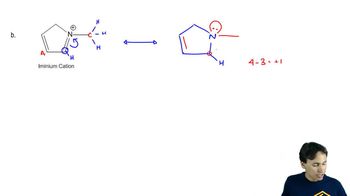
Resonance structures are different Lewis structures for the same molecule that depict the same arrangement of atoms but differ in the placement of electrons. These structures help illustrate the delocalization of electrons within a molecule, which is crucial for understanding its stability and reactivity. The actual structure of the molecule is a resonance hybrid, a weighted average of all valid resonance forms.
추천 영상:
03:04
Drawing Resonance Structures

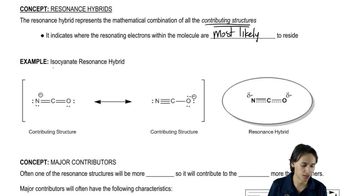
Resonance Hybrid

The resonance hybrid is the actual structure of a molecule that is formed from the combination of its resonance contributors. It represents a more stable configuration than any individual resonance structure due to the delocalization of electrons. The contribution of each resonance structure to the hybrid depends on factors such as formal charge, electronegativity, and overall stability.
추천 영상:
03:24
How to draw a resonance hybrid.

Factors Affecting Resonance Contribution

The contribution of a resonance structure to the resonance hybrid is influenced by several factors, including the stability of the structure, the presence of formal charges, and the arrangement of electrons. Structures with minimal formal charges, full octets, and more electronegative atoms bearing negative charges are generally more stable and thus contribute more significantly to the resonance hybrid. Understanding these factors is essential for predicting the behavior of molecules in chemical reactions.
추천 영상:
14:01
Drawing Contributing Structures