Ch. 8 - Delocalized Electrons: Their Effect on Stability, pKa, and the Products of a Reaction • Aromaticity and Electronic Effects: An Introduction to the Reactions of Benzene
Bruice - Organic Chemistry 8th Edition
Bruice8th EditionOrganic ChemistryISBN: 9780135213711당신이 사용하는 게 아니라요?교과서 변경
8장, 문제 81a,b

Which species in each of the pairs in Problem 80 is the stronger base?
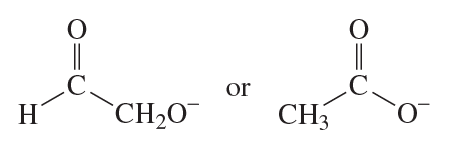
a. Structural formulas comparing two chemical species with hydroxide groups, asking which is the stronger base.
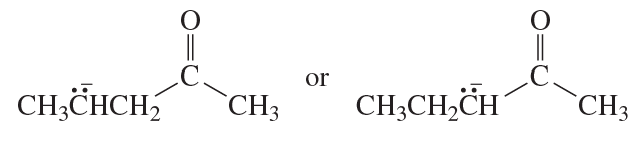
b. Chemical structures comparing two species to determine which is the stronger base, labeled with "or" between them.

검증된 단계별 안내
1
Step 1: Analyze the chemical structures in pair A. The species (i) is the formate ion (HCOO⁻), and species (ii) is the acetate ion (CH₃COO⁻). The difference lies in the substituent attached to the carboxylate group: hydrogen in (i) and a methyl group in (ii).
Step 2: Consider the inductive effect of the substituents. The methyl group in acetate (ii) is electron-donating, which stabilizes the negative charge on the oxygen atom through hyperconjugation and inductive effects. This stabilization reduces the basicity of acetate compared to formate.
Step 3: Conclude that formate (i) is the stronger base in pair A because it lacks the electron-donating methyl group, making the negative charge on the oxygen less stabilized and more available to accept a proton.
Step 4: Analyze the chemical structures in pair B. Both species are enolate ions, but the difference lies in the position of the negative charge. In species (i), the negative charge is on the carbon adjacent to the carbonyl group, while in species (ii), the negative charge is on the carbon further away from the carbonyl group.
Step 5: Consider resonance stabilization. In species (i), the negative charge is delocalized through resonance with the carbonyl group, making it more stable and less basic. In species (ii), the negative charge is less delocalized, making it less stable and more basic. Therefore, species (ii) is the stronger base in pair B.

비슷한 문제에 대한 검증된 영상 답변:

이 영상 해법은 위 문제에 도움이 된다고 튜터들이 추천한 것입니다.
영상 길이:
5m

주요 개념

질문에 올바르게 답하기 위해 반드시 이해해야 하는 핵심 개념들은 다음과 같습니다.

Acidity and Basicity

Acidity refers to the ability of a species to donate a proton (H+), while basicity is the ability to accept a proton. In organic chemistry, the strength of an acid or base is often determined by the stability of its conjugate base or acid. A stronger base corresponds to a weaker acid, and vice versa, which is crucial for comparing the species in the given problem.
추천 영상:
06:21
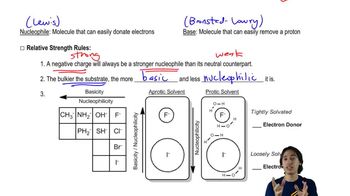
Understanding the difference between basicity and nucleophilicity.

Resonance Stabilization

Resonance stabilization occurs when a molecule can be represented by two or more valid Lewis structures, leading to a delocalization of electrons. This delocalization can stabilize a negative charge in a conjugate base, making it less likely to accept a proton, thus affecting the basicity. Understanding resonance is essential for evaluating the strength of bases in the provided pairs.
추천 영상:
03:43
The radical stability trend.

Inductive Effect

The inductive effect refers to the electron-withdrawing or electron-donating effects of substituents on a molecule, which can influence acidity and basicity. Electronegative atoms or groups can stabilize a negative charge through their electron-withdrawing nature, while electron-donating groups can destabilize it. This concept is important for analyzing the structural differences in the pairs presented in the question.
추천 영상:
01:47
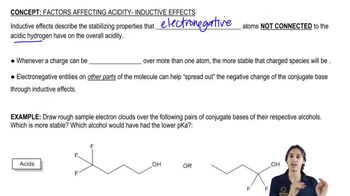
Understanding the Inductive Effect.