Ch. 8 - Delocalized Electrons: Their Effect on Stability, pKa, and the Products of a Reaction • Aromaticity and Electronic Effects: An Introduction to the Reactions of Benzene
Bruice - Organic Chemistry 8th Edition
Bruice8th EditionOrganic ChemistryISBN: 9780135213711당신이 사용하는 게 아니라요?교과서 변경
8장, 문제 41

Write a general rule that can be used to predict the major product of a Diels–Alder reaction between an alkene with an electron-withdrawing substituent and a diene with a substituent that can donate electrons by resonance depending on the location of the substituent on the diene.

검증된 단계별 안내
1
Identify the diene and the dienophile in the reaction. The diene is a conjugated system with alternating double and single bonds, while the dienophile is the alkene with an electron-withdrawing substituent.
Analyze the substituents on the diene. If the diene has an electron-donating group (EDG) that can donate electrons by resonance, it will increase the electron density of the diene, making it more reactive in the Diels–Alder reaction.
Determine the electron-withdrawing group (EWG) on the dienophile. The EWG reduces the electron density of the dienophile, making it more electrophilic and reactive toward the electron-rich diene.
Predict the regioselectivity of the reaction. Use the electron density distribution of the diene and dienophile to determine the most favorable alignment of the reacting centers. This is often guided by the concept of the 'ortho/para' rule, where the most electron-rich carbon of the diene reacts with the most electron-deficient carbon of the dienophile.
Consider the stereochemistry of the reaction. The Diels–Alder reaction is stereospecific, meaning that the stereochemistry of the substituents on the diene and dienophile will be preserved in the product. Ensure that the substituents are aligned to predict the correct stereochemical outcome of the major product.

비슷한 문제에 대한 검증된 영상 답변:

이 영상 해법은 위 문제에 도움이 된다고 튜터들이 추천한 것입니다.
영상 길이:
11m

주요 개념

질문에 올바르게 답하기 위해 반드시 이해해야 하는 핵심 개념들은 다음과 같습니다.

Diels–Alder Reaction

The Diels–Alder reaction is a [4+2] cycloaddition between a conjugated diene and a dienophile, resulting in the formation of a six-membered ring. This reaction is stereospecific and can be influenced by the electronic properties of the substituents on both the diene and the dienophile. Understanding the reactivity and orientation of these components is crucial for predicting the major product.
추천 영상:
04:02
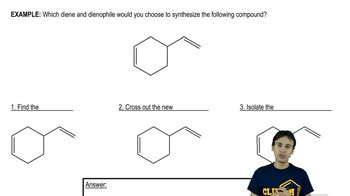
Diels-Alder Retrosynthesis

Electron-Withdrawing and Electron-Donating Groups

Electron-withdrawing groups (EWGs) stabilize negative charges and can enhance the electrophilicity of the dienophile, while electron-donating groups (EDGs) increase the nucleophilicity of the diene. The presence and position of these substituents significantly affect the regioselectivity and stereochemistry of the Diels–Alder reaction, guiding the formation of the major product.
추천 영상:
02:37
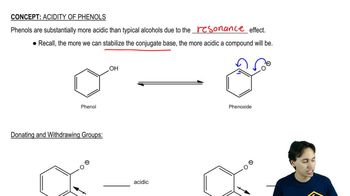
Donating vs Withdrawing Groups

Regioselectivity in Diels–Alder Reactions

Regioselectivity refers to the preference for the formation of one constitutional isomer over others in a chemical reaction. In the context of the Diels–Alder reaction, the position of substituents on the diene and dienophile can lead to different major products. Analyzing the resonance effects and steric factors of the substituents helps predict which product will be favored.
추천 영상:
04:02
Diels-Alder Retrosynthesis