Ch. 9 - Substitution and Elimination Reactions of Alkyl Halides
Bruice - Organic Chemistry 8th Edition
Bruice8th EditionOrganic ChemistryISBN: 9780135213711당신이 사용하는 게 아니라요?교과서 변경
9장, 문제 6b

A small amount of another organic product is formed in a Williamson ether synthesis. What is this product when the alkyl halide used in the synthesis of butyl propyl ether is
b. butyl bromide?

검증된 단계별 안내
1
Understand the Williamson ether synthesis: This reaction involves the reaction of an alkoxide ion (R-O⁻) with an alkyl halide (R'-X) to form an ether (R-O-R'). However, side reactions can occur, especially elimination reactions.
Identify the reactants: In this case, the alkyl halide is butyl bromide (CH₃CH₂CH₂CH₂Br), and the alkoxide ion is propoxide (CH₃CH₂CH₂O⁻), which will form the main product, butyl propyl ether (CH₃CH₂CH₂OCH₂CH₂CH₂CH₃).
Consider the side reaction: The alkyl halide (butyl bromide) can undergo an elimination reaction in the presence of a strong base like the alkoxide ion. This elimination reaction follows the E2 mechanism, where the base abstracts a β-hydrogen from the alkyl halide, leading to the formation of an alkene.
Determine the product of elimination: In the case of butyl bromide, the β-hydrogen is removed, and the double bond forms between the α and β carbons, resulting in 1-butene (CH₂=CHCH₂CH₃) as the side product.
Summarize the side product: The small amount of side product formed in this Williamson ether synthesis is 1-butene, which arises from the E2 elimination of butyl bromide.

비슷한 문제에 대한 검증된 영상 답변:

이 영상 해법은 위 문제에 도움이 된다고 튜터들이 추천한 것입니다.
영상 길이:
4m

주요 개념

질문에 올바르게 답하기 위해 반드시 이해해야 하는 핵심 개념들은 다음과 같습니다.

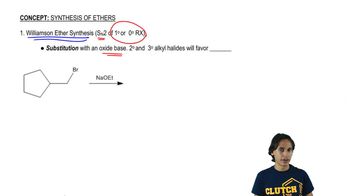
Williamson Ether Synthesis

Williamson ether synthesis is a method for creating ethers through the reaction of an alkoxide ion with a primary alkyl halide. This reaction typically involves nucleophilic substitution, where the alkoxide acts as a nucleophile, attacking the electrophilic carbon of the alkyl halide, resulting in the formation of an ether and a halide ion.
추천 영상:
03:50
The Mechanism of Williamson Ether Synthesis.

Alkyl Halides

Alkyl halides are organic compounds containing a carbon atom bonded to a halogen atom (such as bromine, chlorine, or iodine). In the context of Williamson ether synthesis, the choice of alkyl halide is crucial, as primary alkyl halides favor the desired nucleophilic substitution reaction, while secondary or tertiary halides may lead to elimination reactions instead.
추천 영상:
01:52
How to name alkyl halides

Side Products in Reactions

In organic reactions, side products can form alongside the desired product due to competing reaction pathways. In the case of Williamson ether synthesis, when butyl bromide is used, a common side product is the formation of butane, which occurs if the alkyl halide undergoes elimination instead of substitution, highlighting the importance of reaction conditions and substrate choice.
추천 영상:
가이드 코스
2:52
Side-Chain Reactions of Substituted Pyridines Concept 3