Ch. 9 - Substitution and Elimination Reactions of Alkyl Halides
Bruice - Organic Chemistry 8th Edition
Bruice8th EditionOrganic ChemistryISBN: 9780135213711당신이 사용하는 게 아니라요?교과서 변경
9장, 문제 54

Amines are good nucleophiles, even though they are neutral. How would the rate of an SN2 reaction between an amine and an alkyl halide be affected if the polarity of the solvent is increased?

검증된 단계별 안내
1
Understand the SN2 reaction mechanism: In an SN2 reaction, the nucleophile attacks the electrophilic carbon of the alkyl halide in a single, concerted step, displacing the leaving group. The rate of the reaction depends on the strength of the nucleophile and the nature of the solvent.
Recognize the role of amines as nucleophiles: Amines are good nucleophiles because the lone pair of electrons on the nitrogen atom can readily attack the electrophilic carbon. However, their nucleophilicity can be influenced by the solvent environment.
Consider the effect of solvent polarity: In an SN2 reaction, polar aprotic solvents (e.g., acetone, DMSO) are generally preferred because they do not solvate the nucleophile strongly, allowing it to remain reactive. Polar protic solvents (e.g., water, alcohols) can hydrogen bond with the nucleophile, reducing its nucleophilicity and slowing the reaction.
Analyze the impact of increasing solvent polarity: If the polarity of the solvent is increased, and the solvent is polar protic, the amine nucleophile will be more strongly solvated through hydrogen bonding. This reduces the availability of the lone pair on nitrogen for nucleophilic attack, thereby decreasing the rate of the SN2 reaction.
Conclude the relationship: The rate of the SN2 reaction between the amine and the alkyl halide will decrease if the polarity of the solvent is increased, provided the solvent is polar protic. If the solvent is polar aprotic, the effect on the rate may be less pronounced or negligible.

비슷한 문제에 대한 검증된 영상 답변:

이 영상 해법은 위 문제에 도움이 된다고 튜터들이 추천한 것입니다.
영상 길이:
1m

주요 개념

질문에 올바르게 답하기 위해 반드시 이해해야 하는 핵심 개념들은 다음과 같습니다.

Nucleophilicity

Nucleophilicity refers to the ability of a species to donate an electron pair to an electrophile, forming a chemical bond. Amines, despite being neutral, possess a lone pair of electrons on the nitrogen atom, making them effective nucleophiles. Their nucleophilicity can be influenced by factors such as steric hindrance and the solvent environment.
추천 영상:
08:27
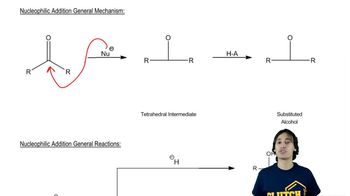
Nucleophilic Addition

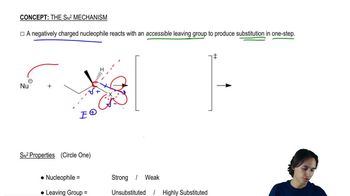
SN2 Reaction Mechanism

The SN2 (substitution nucleophilic bimolecular) reaction mechanism involves a single concerted step where the nucleophile attacks the electrophile, leading to the displacement of a leaving group. This mechanism is characterized by a transition state where both the nucleophile and the substrate are involved. The rate of an SN2 reaction is dependent on the concentration of both the nucleophile and the substrate.
추천 영상:
08:33
Drawing the SN2 Mechanism

Solvent Polarity

Solvent polarity affects the solvation of reactants and transition states in a chemical reaction. In polar solvents, nucleophiles can be stabilized through solvation, which may reduce their reactivity. Increasing solvent polarity generally slows down SN2 reactions because it stabilizes the nucleophile, making it less available to attack the electrophile, thus decreasing the reaction rate.
추천 영상:
01:16
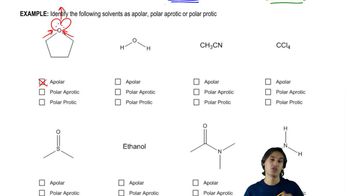
Identification of polarity in solvents