Ch. 9 - Substitution and Elimination Reactions of Alkyl Halides
Bruice - Organic Chemistry 8th Edition
Bruice8th EditionOrganic ChemistryISBN: 9780135213711당신이 사용하는 게 아니라요?교과서 변경
9장, 문제 111a,b

Draw the elimination products for each of the following E2 reactions; if the products can exist as stereoisomers, indicate which stereoisomers are obtained.
a. (2S,3S)-2-chloro-3-methylpentane + high concentration of CH3O−
b. (2S,3R)-2-chloro-3-methylpentane + high concentration of CH3O−

검증된 단계별 안내
1
Step 1: Understand the E2 elimination mechanism. E2 (bimolecular elimination) is a one-step reaction where a base abstracts a proton (β-hydrogen) from the β-carbon, and the leaving group (e.g., Cl⁻) departs simultaneously, forming a double bond. The reaction requires an anti-periplanar geometry between the β-hydrogen and the leaving group.
Step 2: Analyze the structure of (2S, 3S)-2-chloro-3-methylpentane. Draw the molecule in its correct stereochemical configuration. Identify the β-hydrogens on the β-carbons adjacent to the carbon bearing the leaving group (Cl). Ensure you consider the anti-periplanar geometry for elimination.
Step 3: Determine the possible elimination products for (2S, 3S)-2-chloro-3-methylpentane. The double bond will form between the α-carbon (carbon bearing the leaving group) and the β-carbon. Check if the products can exist as stereoisomers (E/Z isomers) based on the substituents around the double bond.
Step 4: Repeat the process for (2S, 3R)-2-chloro-3-methylpentane. Draw the molecule in its correct stereochemical configuration. Identify the β-hydrogens and ensure the anti-periplanar geometry is satisfied for elimination. Predict the possible elimination products and check for stereoisomers.
Step 5: Summarize the elimination products for both (2S, 3S)-2-chloro-3-methylpentane and (2S, 3R)-2-chloro-3-methylpentane. Indicate the stereoisomers (E/Z) obtained for each case, if applicable. Note that the stereochemistry of the starting material influences the stereochemistry of the products due to the anti-periplanar requirement.

비슷한 문제에 대한 검증된 영상 답변:

이 영상 해법은 위 문제에 도움이 된다고 튜터들이 추천한 것입니다.
영상 길이:
7m

주요 개념

질문에 올바르게 답하기 위해 반드시 이해해야 하는 핵심 개념들은 다음과 같습니다.

E2 Mechanism

The E2 mechanism is a type of elimination reaction where a base removes a proton from a β-carbon, leading to the simultaneous departure of a leaving group from the α-carbon. This concerted process results in the formation of a double bond. Understanding the stereochemistry of the starting material is crucial, as it influences the stereochemical outcome of the elimination products.
추천 영상:
09:36
Drawing the E2 Mechanism.

Stereoisomerism

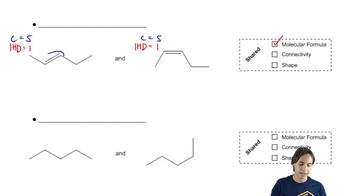
Stereoisomerism refers to the phenomenon where compounds have the same molecular formula and connectivity but differ in the spatial arrangement of atoms. In E2 reactions, the stereochemistry of the starting material can lead to different stereoisomers in the products, such as cis and trans configurations, or E/Z isomers, depending on the orientation of substituents around the double bond formed.
추천 영상:
01:58
Determining when molecules are stereoisomers.

Regioselectivity and Stereoselectivity

Regioselectivity and stereoselectivity are important concepts in elimination reactions. Regioselectivity refers to the preference for the formation of one constitutional isomer over others, while stereoselectivity indicates the preference for one stereoisomer over another. In E2 reactions, the orientation of the leaving group and the hydrogen being removed can lead to different regio- and stereoisomeric products, which must be considered when predicting the outcomes.
추천 영상:
05:09
Heck Reaction