Ch. 9 - Substitution and Elimination Reactions of Alkyl Halides
Bruice - Organic Chemistry 8th Edition
Bruice8th EditionOrganic ChemistryISBN: 9780135213711당신이 사용하는 게 아니라요?교과서 변경
9장, 문제 47a

Draw the elimination products that are formed when 3-bromo-3-methyl-1-butene reacts with
a. CH3O−.

검증된 단계별 안내
1
Identify the type of elimination reaction: The reaction involves CH3O− (methoxide ion), which is a strong base. This suggests that the reaction will proceed via an E2 (bimolecular elimination) mechanism.
Locate the β-hydrogens: In the structure of 3-bromo-3-methyl-1-butene, identify the β-carbons (carbons adjacent to the carbon bonded to the bromine atom). Check for hydrogens attached to these β-carbons.
Determine the possible elimination pathways: In an E2 reaction, the base (CH3O−) abstracts a β-hydrogen, and the leaving group (Br−) departs simultaneously, forming a double bond. Analyze the structure to determine which β-hydrogens can be removed and the resulting double bond locations.
Apply Zaitsev's rule: Zaitsev's rule states that the more substituted alkene is generally the major product. Compare the possible alkenes formed to determine which is more substituted and thus more likely to be the major product.
Draw the elimination products: Illustrate the structures of all possible alkenes formed, labeling the major and minor products based on substitution and stability. Ensure the double bonds are placed correctly in the products.

비슷한 문제에 대한 검증된 영상 답변:

이 영상 해법은 위 문제에 도움이 된다고 튜터들이 추천한 것입니다.
영상 길이:
2m

주요 개념

질문에 올바르게 답하기 위해 반드시 이해해야 하는 핵심 개념들은 다음과 같습니다.

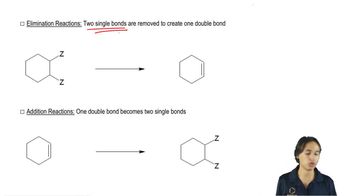
Elimination Reactions

Elimination reactions involve the removal of a small molecule from a larger one, resulting in the formation of a double bond. In organic chemistry, these reactions often occur in the context of alkenes, where a leaving group (like a halide) and a hydrogen atom are eliminated. Understanding the mechanism of elimination, such as E2 or E1 pathways, is crucial for predicting the products formed.
추천 영상:
00:40
Recognizing Elimination Reactions.

Nucleophiles

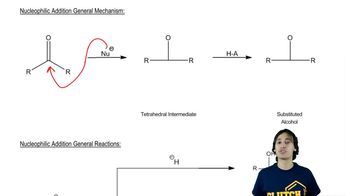
Nucleophiles are species that donate an electron pair to form a chemical bond in a reaction. In this context, CH3O− (methoxide ion) acts as a strong nucleophile that can attack the electrophilic carbon atom, facilitating the elimination process. Recognizing the role of nucleophiles helps in understanding how they influence the reaction pathway and the resulting products.
추천 영상:
08:27
Nucleophilic Addition

Regioselectivity

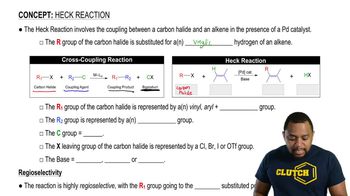
Regioselectivity refers to the preference of a chemical reaction to yield one structural isomer over others when multiple products are possible. In the case of elimination reactions, the stability of the resulting alkene can dictate which product is favored. For 3-bromo-3-methyl-1-butene, understanding regioselectivity is essential to predict whether the more stable or less stable alkene will be formed.
추천 영상:
05:09
Heck Reaction