Ch. 9 - Substitution and Elimination Reactions of Alkyl Halides
Bruice - Organic Chemistry 8th Edition
Bruice8th EditionOrganic ChemistryISBN: 9780135213711당신이 사용하는 게 아니라요?교과서 변경
9장, 문제 84c

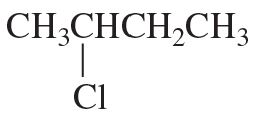
Draw the major product obtained when an alkyl halide in [PROBLEM 9-83] undergoes an E1 reaction.
c. Structural formula of an alkyl halide with a chlorine atom attached, indicating an E1 reaction scenario.

검증된 단계별 안내
1
Step 1: Identify the alkyl halide structure provided in the image. The molecule is a cyclohexyl bromide, where bromine is attached to a cyclohexane ring.
Step 2: Understand the E1 reaction mechanism. E1 reactions proceed via a two-step process: (1) the leaving group (Br) departs, forming a carbocation intermediate, and (2) a proton is removed from a β-carbon, leading to the formation of a double bond.
Step 3: Determine the stability of the carbocation intermediate. When bromine leaves, a cyclohexyl carbocation is formed. This carbocation is relatively stable due to the ring structure and hyperconjugation effects.
Step 4: Identify the β-hydrogens available for elimination. In the cyclohexyl carbocation, hydrogens on the carbons adjacent to the carbocation (β-carbons) are potential candidates for elimination. Removing one of these hydrogens will result in the formation of a double bond.
Step 5: Predict the major product. The major product will be the most stable alkene formed by elimination. In this case, the double bond will likely form between the carbocation carbon and one of the β-carbons, resulting in a cyclohexene structure.

비슷한 문제에 대한 검증된 영상 답변:

이 영상 해법은 위 문제에 도움이 된다고 튜터들이 추천한 것입니다.
영상 길이:
4m

주요 개념

질문에 올바르게 답하기 위해 반드시 이해해야 하는 핵심 개념들은 다음과 같습니다.

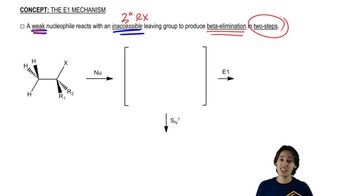
E1 Reaction Mechanism

The E1 reaction mechanism is a type of elimination reaction that involves two steps: the formation of a carbocation intermediate followed by the loss of a proton to form a double bond. This mechanism typically occurs with tertiary or some secondary alkyl halides, where the stability of the carbocation is a key factor in the reaction's feasibility.
추천 영상:
08:09
Drawing the E1 Mechanism.

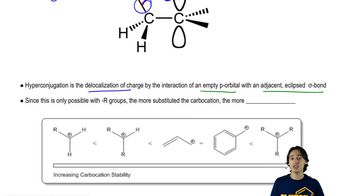
Carbocation Stability

Carbocation stability is crucial in E1 reactions, as more stable carbocations are formed preferentially. Stability increases with the degree of substitution: tertiary carbocations are more stable than secondary, which are more stable than primary. This stability influences the rate of the reaction and the major product formed.
추천 영상:
05:58
Determining Carbocation Stability

Regioselectivity in Elimination Reactions

Regioselectivity refers to the preference of a chemical reaction to yield one structural isomer over others. In E1 reactions, the formation of the double bond can lead to different alkene products, and the more substituted alkene (Zaitsev's rule) is typically favored due to greater stability. Understanding regioselectivity helps predict the major product in elimination reactions.
추천 영상:
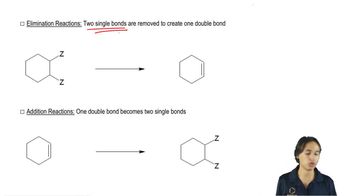
00:40
Recognizing Elimination Reactions.