Ch. 9 - Substitution and Elimination Reactions of Alkyl Halides
Bruice - Organic Chemistry 8th Edition
Bruice8th EditionOrganic ChemistryISBN: 9780135213711당신이 사용하는 게 아니라요?교과서 변경
9장, 문제 38a

Draw the substitution and elimination products for the following reactions, showing the configuration of each product:
a. trans-1-chloro-2-methylcyclohexane + CH3O−

검증된 단계별 안내
1
Analyze the structure of the starting material, trans-1-chloro-2-methylcyclohexane. The chlorine atom is on one carbon of the cyclohexane ring, and the methyl group is on the adjacent carbon. Since the molecule is trans, the chlorine and methyl groups are on opposite sides of the ring (one axial and one equatorial).
Determine the type of reaction mechanism that can occur with CH3O⁻ (methoxide ion). CH3O⁻ is a strong base and a strong nucleophile, so both substitution (S_N2) and elimination (E2) reactions are possible. The reaction pathway depends on steric and electronic factors.
For the substitution (S_N2) pathway: The methoxide ion will attack the carbon bonded to the chlorine atom (the leaving group). Since S_N2 reactions proceed via a backside attack, the stereochemistry of the product will invert at the carbon where substitution occurs. Draw the product with the methoxy group replacing the chlorine, ensuring the stereochemistry is inverted.
For the elimination (E2) pathway: The methoxide ion will abstract a β-hydrogen (a hydrogen on a carbon adjacent to the carbon bearing the chlorine). In this case, the β-hydrogen must be anti-periplanar to the chlorine atom for the elimination to occur. Identify the anti-periplanar β-hydrogen, and draw the resulting alkene product. Ensure the double bond is formed between the carbon bearing the chlorine and the β-carbon, and show the correct stereochemistry of the alkene.
Summarize the products: For substitution, the product is the inverted stereochemical product with the methoxy group. For elimination, the product is the alkene with the correct stereochemistry based on the anti-periplanar geometry. Ensure both products are clearly drawn with their configurations labeled.

비슷한 문제에 대한 검증된 영상 답변:

이 영상 해법은 위 문제에 도움이 된다고 튜터들이 추천한 것입니다.
영상 길이:
4m

주요 개념

질문에 올바르게 답하기 위해 반드시 이해해야 하는 핵심 개념들은 다음과 같습니다.

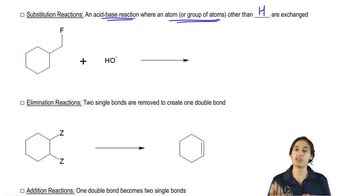
Substitution Reactions

Substitution reactions involve the replacement of one atom or group in a molecule with another atom or group. In organic chemistry, nucleophilic substitution is common, where a nucleophile attacks an electrophilic carbon, leading to the formation of a new bond while the leaving group departs. Understanding the mechanism (SN1 or SN2) is crucial, as it influences the stereochemistry and regioselectivity of the products.
추천 영상:
01:34
Recognizing Substitution Reactions.

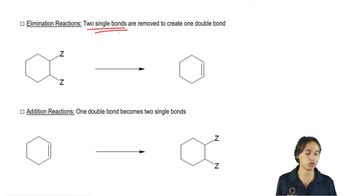
Elimination Reactions

Elimination reactions involve the removal of a small molecule (often water or a halide) from a larger molecule, resulting in the formation of a double bond. In organic chemistry, common types include E1 and E2 mechanisms. The choice between substitution and elimination often depends on the structure of the substrate and the conditions of the reaction, such as the strength of the base used.
추천 영상:
00:40
Recognizing Elimination Reactions.

Stereochemistry

Stereochemistry refers to the spatial arrangement of atoms in molecules and how this affects their chemical behavior. In reactions involving chiral centers, the configuration (R/S) of products is critical, as it can influence the reactivity and properties of the compounds formed. Understanding stereochemistry is essential for predicting the outcomes of substitution and elimination reactions, especially in cyclic compounds like cyclohexane.
추천 영상:
가이드 코스
1:38
Polymer Stereochemistry Concept 1