Ch. 9 - Substitution and Elimination Reactions of Alkyl Halides
Bruice - Organic Chemistry 8th Edition
Bruice8th EditionOrganic ChemistryISBN: 9780135213711당신이 사용하는 게 아니라요?교과서 변경
9장, 문제 77e,f

Draw the substitution products for each of the following reactions; if the products can exist as stereoisomers, show what stereoisomers are obtained:
e. 1-bromo-2-butene + CH3O−
f. 1-bromo-2-butene + CH3OH

검증된 단계별 안내
1
Step 1: Analyze the substrate (1-bromo-2-butene) and the nucleophile/base in each reaction. For part (e), the nucleophile is CH3O− (a strong nucleophile and base), and for part (f), the nucleophile is CH3OH (a weak nucleophile and solvent).
Step 2: Determine the mechanism for each reaction. For part (e), the strong nucleophile CH3O− suggests an SN2 mechanism, where the nucleophile attacks the carbon bonded to the bromine in a single concerted step. For part (f), the weak nucleophile CH3OH suggests an SN1 mechanism, where the bromine leaves first to form a carbocation intermediate, followed by nucleophilic attack.
Step 3: For part (e), in the SN2 mechanism, the nucleophile CH3O− will attack the carbon bonded to the bromine from the opposite side (backside attack), leading to inversion of configuration at the carbon center. Since the carbon is sp2 hybridized (planar) in 1-bromo-2-butene, stereoisomerism is not a concern here.
Step 4: For part (f), in the SN1 mechanism, the bromine leaves first, forming a carbocation intermediate. The carbocation is planar and can be attacked by CH3OH from either side, leading to the formation of two stereoisomers (R and S configurations) if the carbon is chiral after substitution.
Step 5: Draw the products for each reaction. For part (e), the product will be 2-methoxy-2-butene. For part (f), the products will be two stereoisomers of 2-methoxy-2-butene if chirality is present. Ensure to show the stereochemistry explicitly in the products for part (f).

비슷한 문제에 대한 검증된 영상 답변:

이 영상 해법은 위 문제에 도움이 된다고 튜터들이 추천한 것입니다.
영상 길이:
4m

주요 개념

질문에 올바르게 답하기 위해 반드시 이해해야 하는 핵심 개념들은 다음과 같습니다.

Nucleophilic Substitution Reactions

Nucleophilic substitution reactions involve the replacement of a leaving group in a molecule by a nucleophile. In the context of the given reactions, the nucleophile (CH3O− or CH3OH) attacks the carbon atom bonded to the bromine atom, leading to the formation of new products. Understanding the mechanism, whether it follows an SN1 or SN2 pathway, is crucial for predicting the structure and stereochemistry of the products.
추천 영상:
01:47
Nucleophiles and Electrophiles can react in Substitution Reactions.

Stereochemistry

Stereochemistry refers to the study of the spatial arrangement of atoms in molecules and how this affects their chemical behavior. In the reactions provided, the formation of stereoisomers is possible due to the presence of chiral centers in the products. Recognizing how the nucleophile approaches the substrate can help determine the stereochemical outcomes, including whether enantiomers or diastereomers are formed.
추천 영상:
가이드 코스
1:38
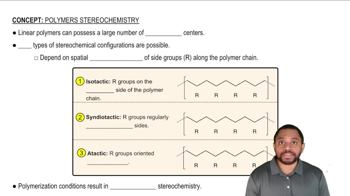
Polymer Stereochemistry Concept 1

Alkenes and Electrophilic Addition

Alkenes, such as 1-bromo-2-butene, can undergo electrophilic addition reactions where the double bond reacts with electrophiles. In the context of the reactions, the alkene can react with the nucleophiles to form substitution products. Understanding the reactivity of alkenes and the nature of the electrophiles involved is essential for predicting the products and their stereochemical configurations.
추천 영상:
09:23
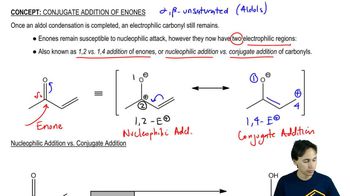
1,2 vs 1,4 Addition
관련 실천