Ch. 9 - Substitution and Elimination Reactions of Alkyl Halides
Bruice - Organic Chemistry 8th Edition
Bruice8th EditionOrganic ChemistryISBN: 9780135213711당신이 사용하는 게 아니라요?교과서 변경
9장, 문제 130

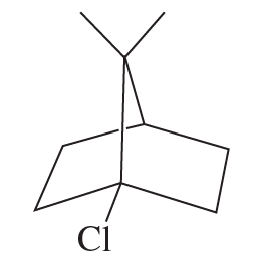
Explain why the following alkyl halide does not undergo a substitution reaction, regardless of the base that is used.
Skeletal structure of an alkyl halide with a chlorine atom, illustrating its inability to undergo substitution reactions.

검증된 단계별 안내
1
Analyze the structure of the alkyl halide provided in the image. The molecule contains a bromine atom attached to a highly sterically hindered carbon center, which is part of a bicyclic system.
Understand the mechanism of substitution reactions. Substitution reactions, such as SN1 and SN2, require either the formation of a carbocation intermediate (SN1) or direct attack by a nucleophile (SN2). Both mechanisms are affected by steric hindrance and the stability of intermediates.
For an SN1 reaction, the bromine would need to leave, forming a carbocation. However, the carbon attached to bromine is part of a rigid bicyclic structure, making carbocation formation highly unstable due to strain and steric hindrance. This prevents the SN1 pathway.
For an SN2 reaction, the nucleophile would need to directly attack the carbon bonded to bromine. The bulky bicyclic structure creates significant steric hindrance, blocking the nucleophile from accessing the carbon atom. This prevents the SN2 pathway.
Conclude that the combination of steric hindrance and the instability of potential intermediates makes this alkyl halide unreactive in substitution reactions, regardless of the base or nucleophile used.

비슷한 문제에 대한 검증된 영상 답변:

이 영상 해법은 위 문제에 도움이 된다고 튜터들이 추천한 것입니다.
영상 길이:
5m

주요 개념

질문에 올바르게 답하기 위해 반드시 이해해야 하는 핵심 개념들은 다음과 같습니다.

Steric Hindrance

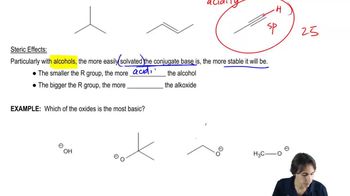
Steric hindrance refers to the prevention of chemical reactions due to the spatial arrangement of atoms within a molecule. In bulky alkyl halides, such as the one shown, the presence of large groups around the reactive site can obstruct the approach of nucleophiles, making substitution reactions less favorable or impossible.
추천 영상:
02:53
Understanding steric effects.

Substitution Mechanisms (SN1 and SN2)

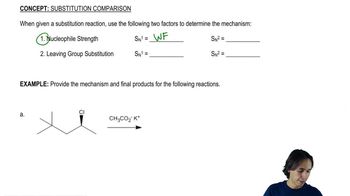
Substitution reactions can occur via two primary mechanisms: SN1 and SN2. SN1 reactions involve a two-step process where the leaving group departs first, forming a carbocation, while SN2 reactions involve a single concerted step where the nucleophile attacks the substrate as the leaving group departs. The structure of the alkyl halide influences which mechanism is favored; in this case, steric hindrance may prevent both mechanisms from occurring.
추천 영상:
03:32
How do we predict if the mechanism is SN1 or SN2?

Carbocation Stability

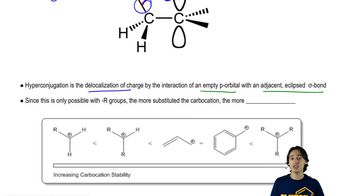
Carbocation stability is crucial in determining the feasibility of substitution reactions. Tertiary carbocations are more stable than secondary or primary ones due to hyperconjugation and inductive effects from surrounding alkyl groups. If the alkyl halide cannot form a stable carbocation due to steric hindrance, it will not undergo substitution, regardless of the base used.
추천 영상:
05:58
Determining Carbocation Stability