Ch. 9 - Substitution and Elimination Reactions of Alkyl Halides
Bruice - Organic Chemistry 8th Edition
Bruice8th EditionOrganic ChemistryISBN: 9780135213711당신이 사용하는 게 아니라요?교과서 변경
9장, 문제 89c

For each of the following reactions, draw the major elimination product; if the product can exist as stereoisomers, indicate which stereoisomer is obtained in greater yield.
c. trans-1-chloro-2-methylcyclohexane + high concentration of CH3O−

검증된 단계별 안내
1
Identify the type of elimination reaction: The presence of a strong base like CH3O− (methoxide ion) and high concentration suggests that this reaction will proceed via the E2 (bimolecular elimination) mechanism.
Analyze the substrate structure: The substrate is trans-1-chloro-2-methylcyclohexane, a cyclohexane ring with a chlorine atom and a methyl group in a trans relationship. In an E2 reaction, the β-hydrogen (hydrogen on the carbon adjacent to the carbon bearing the leaving group) must be anti-periplanar (in opposite planes) to the leaving group (Cl).
Determine the anti-periplanar β-hydrogen: Draw the chair conformation of trans-1-chloro-2-methylcyclohexane. Place the chlorine atom in the axial position and the methyl group in the equatorial position to satisfy the trans relationship. Identify the β-hydrogens that are anti-periplanar to the chlorine atom.
Predict the major elimination product: The E2 mechanism will result in the formation of a double bond between the α-carbon (the carbon bearing the leaving group) and the β-carbon (the carbon with the anti-periplanar β-hydrogen). Use Zaitsev's rule to predict that the more substituted alkene (the one with the greater number of alkyl groups attached to the double-bonded carbons) will be the major product.
Consider stereochemistry: If the product can exist as stereoisomers, determine which stereoisomer is favored. In this case, the anti-periplanar geometry of the E2 transition state will dictate the stereochemistry of the product. Draw the major stereoisomer based on this geometry.

비슷한 문제에 대한 검증된 영상 답변:

이 영상 해법은 위 문제에 도움이 된다고 튜터들이 추천한 것입니다.
영상 길이:
7m

주요 개념

질문에 올바르게 답하기 위해 반드시 이해해야 하는 핵심 개념들은 다음과 같습니다.

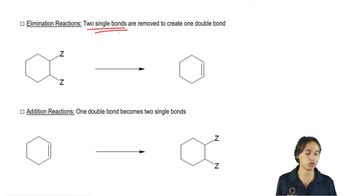
Elimination Reactions

Elimination reactions involve the removal of atoms or groups from a molecule, resulting in the formation of a double bond. In organic chemistry, the most common types are E1 and E2 mechanisms. E2 reactions are concerted, meaning the bond-breaking and bond-forming occur simultaneously, while E1 reactions proceed through a carbocation intermediate. Understanding the mechanism is crucial for predicting the structure of the elimination product.
추천 영상:
00:40
Recognizing Elimination Reactions.

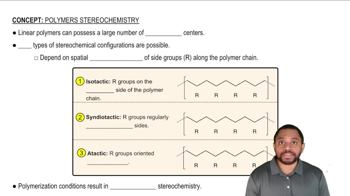
Stereochemistry

Stereochemistry is the study of the spatial arrangement of atoms in molecules and how this affects their chemical behavior. In elimination reactions, the stereochemistry of the starting material can influence the stereochemical outcome of the product. For example, the formation of cis or trans isomers can occur depending on the orientation of the leaving groups and the resulting double bond, which is essential for determining the major product.
추천 영상:
가이드 코스
1:38
Polymer Stereochemistry Concept 1

Regioselectivity and Stereoselectivity

Regioselectivity refers to the preference of a chemical reaction to yield one structural isomer over others, while stereoselectivity indicates the preference for one stereoisomer over another. In the context of elimination reactions, factors such as steric hindrance and the stability of the resulting double bond can influence which product is formed in greater yield. Recognizing these preferences is key to predicting the major elimination product from the given substrate.
추천 영상:
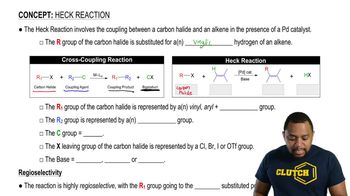
05:09
Heck Reaction