

Ch. 9 - Substitution and Elimination Reactions of Alkyl Halides
Bruice - Organic Chemistry 8th Edition
Bruice8th EditionOrganic ChemistryISBN: 9780135213711당신이 사용하는 게 아니라요?교과서 변경
9장, 문제 3a

How will the rate of the reaction between bromomethane and hydroxide ion be affected if the following changes in concentration are made?
a. The concentration of the alkyl halide is not changed and the concentration of the nucleophile is tripled.

검증된 단계별 안내
1
Understand the reaction mechanism: The reaction between bromomethane (CH₃Br) and hydroxide ion (OH⁻) follows an SN2 (bimolecular nucleophilic substitution) mechanism. In an SN2 reaction, the rate depends on the concentrations of both the alkyl halide and the nucleophile.
Write the rate law for the SN2 reaction: The rate law for an SN2 reaction is given by: r=k⁢[CH3Br]⁢[OH-], where k is the rate constant, [CH3Br] is the concentration of bromomethane, and [OH-] is the concentration of hydroxide ion.
Analyze the change in concentration: In this scenario, the concentration of the alkyl halide ([CH3Br]) remains constant, while the concentration of the nucleophile ([OH-]) is tripled.
Substitute the changes into the rate law: Since the rate is directly proportional to the concentration of the nucleophile, tripling [OH-] will result in the rate being tripled as well. Mathematically, r'=k⁢[CH3Br]⁢(3⁢[OH-])=3r.
Conclude the effect on the reaction rate: The rate of the reaction will increase by a factor of 3 when the concentration of the nucleophile is tripled, while the concentration of the alkyl halide remains unchanged.

비슷한 문제에 대한 검증된 영상 답변:

이 영상 해법은 위 문제에 도움이 된다고 튜터들이 추천한 것입니다.
영상 길이:
2m

주요 개념

질문에 올바르게 답하기 위해 반드시 이해해야 하는 핵심 개념들은 다음과 같습니다.

Nucleophilic Substitution Reactions

Nucleophilic substitution reactions involve the replacement of a leaving group in a molecule by a nucleophile. In this context, bromomethane (an alkyl halide) reacts with hydroxide ion (a nucleophile) to form methanol and bromide ion. The rate of these reactions can depend on the concentrations of the reactants and the mechanism (SN1 or SN2) involved.
추천 영상:
01:47
Nucleophiles and Electrophiles can react in Substitution Reactions.

Reaction Rate and Concentration

The rate of a chemical reaction is influenced by the concentrations of the reactants. According to the rate law, if the concentration of a reactant increases, the rate of reaction typically increases as well, assuming the reaction order with respect to that reactant is greater than zero. In this case, tripling the concentration of the hydroxide ion is likely to increase the reaction rate.
추천 영상:
가이드 코스
5:07
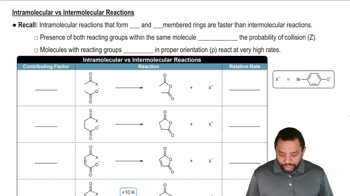
Rates of Intramolecular Reactions Concept 2

Order of Reaction

The order of a reaction refers to the power to which the concentration of a reactant is raised in the rate law. For nucleophilic substitution reactions, the order can vary based on the mechanism. For an SN2 reaction, the rate is first order with respect to both the alkyl halide and the nucleophile, meaning that tripling the nucleophile's concentration will significantly enhance the reaction rate.
추천 영상:
01:42
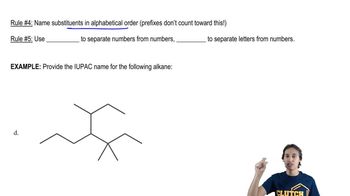
Proper name ordering and punctuation