Ch. 9 - Substitution and Elimination Reactions of Alkyl Halides
Bruice - Organic Chemistry 8th Edition
Bruice8th EditionOrganic ChemistryISBN: 9780135213711당신이 사용하는 게 아니라요?교과서 변경
9장, 문제 27

If 2-fluoropentane could undergo an E1 reaction, would you expect the major product to be the more stable alkene or the less stable alkene? Explain your answer.

검증된 단계별 안내
1
Identify the reaction type: An E1 reaction (unimolecular elimination) involves the formation of a carbocation intermediate as the rate-determining step. This means the stability of the carbocation plays a critical role in the reaction pathway.
Analyze the substrate: 2-fluoropentane has a fluorine atom attached to the second carbon of a pentane chain. Fluorine is an electronegative atom, and while it is not a good leaving group, we are assuming the reaction proceeds under conditions that allow elimination.
Determine the carbocation stability: When the fluorine leaves, a secondary carbocation forms at the second carbon. Secondary carbocations are moderately stable, but rearrangements to form a more stable carbocation (e.g., tertiary) are possible if the structure allows.
Predict the product: In an E1 reaction, the major product is typically the more stable alkene. This follows Zaitsev's rule, which states that elimination favors the formation of the more substituted (and thus more stable) alkene. This is because the stability of the alkene increases with the number of alkyl groups attached to the double-bonded carbons.
Conclude the reasoning: Since the E1 mechanism favors the formation of the more stable alkene, the major product of the reaction would be the more substituted alkene. This is due to the thermodynamic stability of the product, which is influenced by hyperconjugation and alkyl group electron-donating effects.

비슷한 문제에 대한 검증된 영상 답변:

이 영상 해법은 위 문제에 도움이 된다고 튜터들이 추천한 것입니다.
영상 길이:
11m

주요 개념

질문에 올바르게 답하기 위해 반드시 이해해야 하는 핵심 개념들은 다음과 같습니다.

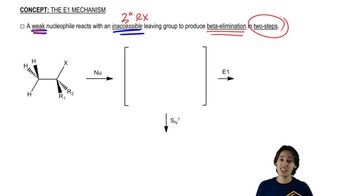
E1 Reaction Mechanism

The E1 reaction is a two-step elimination process where the first step involves the formation of a carbocation intermediate after the leaving group departs. The stability of the carbocation significantly influences the reaction pathway, as more stable carbocations (tertiary > secondary > primary) are favored. The second step involves the deprotonation of a neighboring carbon to form the alkene product.
추천 영상:
08:09
Drawing the E1 Mechanism.

Carbocation Stability

Carbocation stability is crucial in determining the outcome of E1 reactions. Tertiary carbocations are more stable than secondary or primary due to hyperconjugation and inductive effects from surrounding alkyl groups. In the case of 2-fluoropentane, the formation of a more stable carbocation will lead to a more favorable reaction pathway, influencing the major product formed.
추천 영상:
05:58
Determining Carbocation Stability

Zaitsev's Rule

Zaitsev's Rule states that in elimination reactions, the more substituted alkene (more stable) is typically the major product. This is because more substituted alkenes have greater stability due to hyperconjugation and steric factors. Therefore, if 2-fluoropentane undergoes an E1 reaction, we would expect the major product to be the more stable alkene, aligning with Zaitsev's Rule.
추천 영상:
01:18
Defining Zaitsev’s Rule